
Arriving at Incheon Airport: AREX, T-money & Getting to Seoul
Incheon International Airport (ICN) is South Korea's primary international gateway, handling the vast majority of long-haul flights from Europe, the Americas, and Southeast Asia — verify your terminal before planning ground transport, as some regional Asian routes operate from Gimpo Airport (GMP) instead. The fastest path from ICN to central Seoul is the AREX Airport Railroad Express direct service: it runs 38 minutes nonstop to Seoul Station [1], requires no transfers, features wide luggage-friendly carriages, and costs ₩11,000 (~$8 USD) [1]. Once in Seoul, the single most important transit tool is the T-money card — a rechargeable IC card accepted on subways, city buses, and many taxis nationwide, purchased at any GS25, CU, or 7-Eleven convenience store for a ₩2,500 deposit [1]. Before boarding your flight, install three apps: Naver Maps (the most accurate transit routing tool in Korea), Kakao T (English-interface taxi booking), and Korail for inter-city train reservations.
Quick Answer: The AREX direct train takes 38 minutes from Incheon Airport to Seoul Station and costs ₩11,000 (~$8 USD) with no transfers. Pick up a T-money IC card (₩2,500 deposit) at any airport convenience store — it covers subway, buses, and most city transport for your entire week.
The AREX departs from dedicated underground platforms beneath Terminal 1 and Terminal 2 at Incheon. Trains run frequently throughout the day; during peak morning hours (7–9 AM), allow extra time at ticket machines if you have not pre-loaded a transit card. The direct express service is the one to take — the all-stop commuter service covers the same route in roughly 66 minutes and is designed for local commuters, not luggage-carrying visitors. Tickets can be purchased at airport kiosks or the AREX desk; to use T-money on the express, the card must be topped up to at least ₩11,000 [1].
The T-money card simplifies transit decisions for the rest of the week. Top it up at station kiosks, GS25, CU, or 7-Eleven — minimum top-up is ₩1,000. Using T-money on city buses and subways provides a small transfer discount over single-use paper tickets. For taxis, Kakao T's English interface makes hailing a cab straightforward without needing to speak Korean; international credit cards work in-app. Budget ₩5,000–10,000 per day for transit within Seoul and a similar amount within Busan [2].
Travelers arriving at Gimpo Airport (GMP) face a shorter transfer: Seoul Metro Line 5 and the AREX all-stop service both connect GMP to the city center in 40–55 minutes. GMP serves regional routes including flights from Tokyo Haneda, Osaka Itami, Beijing Capital, and Shanghai Hongqiao — K-pop fans traveling directly from Japan or China frequently arrive here rather than at Incheon.
Seoul Days 1–2: Palaces, Hanok Alleys & Night Market Streets
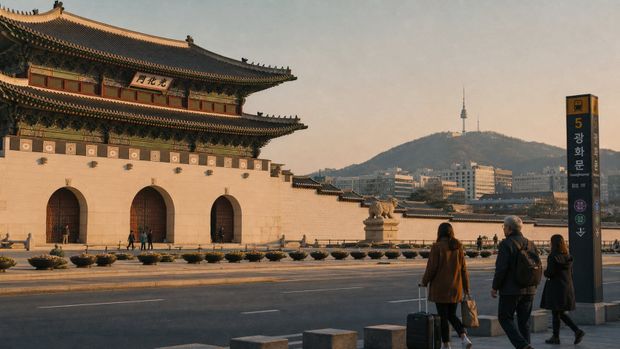
Seoul's first two days reward an approach that alternates between the city's Joseon-era heritage sites and its street market culture — two dimensions that sit within easy walking distance of each other north of the Han River. Gyeongbokgung Palace, built in 1395 as the principal royal palace of the Joseon Dynasty [4], anchors Day 1. Admission is free if you arrive wearing rented hanbok (traditional Korean dress), with rental shops clustered in the streets surrounding the palace charging ₩15,000–30,000 per hour [1]. The Royal Guard Changing Ceremony runs at 10 AM and 2 PM daily at Gwanghwamun Gate and requires no separate ticket — arrive a few minutes early to secure a viewing position. After the palace, the 900+ preserved tile-roof Joseon-era houses of Bukchon Hanok Village, a 15-minute walk northeast, reward visitors who arrive before 9 AM: the lanes are quieter, light is better for photography, and you avoid the mid-morning tour group surge that fills the ridge from 9:30 AM onward on weekends [3].
📍 View Gyeongbokgung Palace on Google Maps
Bukchon Hanok Village is a functioning residential neighbourhood, not a museum — residents still live in the hanok houses lining the steep lanes of Gahoe-dong. Keeping noise to a minimum is both courteous and posted on signage at the main entry points. The village is best explored on foot without a fixed route; the network of alleyways rewards slow wandering and reveals unexpected viewpoints down to the palace grounds below. The most-photographed viewpoint on the main ridge fills rapidly from 9:30 AM onward on weekends, so early arrival pays off in both atmosphere and photography.
📍 View Bukchon Hanok Village on Google Maps
Day 2 pivots to Seoul's market culture. Gwangjang Market — Korea's oldest continuously operating traditional market — reaches its energy peak between 3 and 6 PM, when the raw ingredients section gives way to a dense grid of food stalls. The two items to seek out are bindaetteok (mung-bean pancakes fried crisp at the edge and soft at the center) and mayak gimbap ("drug rolls" — bite-size seaweed rice rolls dipped in mustard-soy sauce, named for their reputedly addictive quality) [3]. A single serving of either runs ₩3,000–5,000. The market sits adjacent to Jongno-5-ga Station on Seoul Metro Line 1.
📍 View Gwangjang Market on Google Maps
Start Day 2 in the morning at Ikseon-dong, a compact hanok neighbourhood converted into artisan cafés, independent boutiques, and small galleries — best visited before 11 AM before the lanes become crowded. From there, loop into Gwangjang Market for the afternoon food peak, then head south to Myeongdong, where the night market opens from roughly 3–4 PM and vendors trade until 10–11 PM. The standard Myeongdong circuit covers tteokbokki (spicy rice cakes), hotteok (filled sweet pancakes), and Korean-style corn dogs, all from carts within a concentrated pedestrian zone that becomes increasingly lively after 6 PM [2].
📍 View Ikseon-dong on Google Maps
📍 View Myeongdong Night Market on Google Maps
Seoul Days 3–4: Hongdae, K-Pop Landmarks & Gangnam
The second half of Seoul shifts to the districts that define the city's contemporary music culture and design identity. Hongdae — the area surrounding Hongik University in western Seoul — is the creative nucleus of Korea's indie and street-performance scene: on any given afternoon the pedestrian plaza outside Hongik University Station hosts singers, dance crews, and instrumentalists performing for audiences that gather and disperse fluidly. Beyond street performance, the neighbourhood contains a concentrated strip of K-fashion boutiques, fan merchandise shops, and concept cafés themed around specific K-pop acts. Mornings are quieter; Hongdae fully wakes from noon onward and stays active well past midnight on weekends [2]. For fans specifically, this neighbourhood yields the highest likelihood of unplanned encounters with album release events, pop-up merchandise stores, and flash fan gatherings aligned with comebacks.
South of the Han River, Gangnam district offers several K-pop-adjacent landmarks within easy walking distance of each other. K-Star Road, stretching through Apgujeong and Cheongdam, is lined with the COKODOT bear statues representing major K-pop groups — each bear is dressed in that act's characteristic styling and has become a recognized fan photo point [3]. A short walk away, COEX Mall contains the Starfield Library — an architectural atrium filled floor-to-ceiling with bookshelves — arrive before 11 AM for unobstructed photographs before mall crowds build. The SM Entertainment flagship store in the same complex carries official merchandise for SM-label artists. Check ahead whether any fan sign meetings or media showcases are scheduled at Dongdaemun Design Plaza (DDP) — Zaha Hadid's sweeping aluminum-and-concrete landmark near Dongdaemun History & Culture Park station frequently hosts brand pop-ups, album launch exhibitions, and K-pop fan events [2].
📍 View K-Star Road on Google Maps
📍 View Dongdaemun Design Plaza (DDP) on Google Maps
For the evening of Day 3 or 4, the Namsan Cable Car (₩21,000 round-trip for adults) [2] ascends to N Seoul Tower, which sits at 479 m above sea level on Namsan Mountain. The observation deck provides a panoramic view across the Seoul basin, particularly impressive at dusk when the city's dense grid of lights emerges. The love-lock fence at the tower base — thousands of padlocks attached over decades — is one of Seoul's more recognized informal landmarks. For a ground-level alternative, Yeouido Hangang Park on the north bank of the Han River is free, open late, and a popular gathering spot with food carts along the riverside path.
📍 View N Seoul Tower on Google Maps
📍 View Yeouido Hangang Park on Google Maps
An optional DMZ day trip can replace one Seoul day for those wanting to visit the Korean Demilitarized Zone. Guided tours depart from central Seoul and cover Panmunjom (Joint Security Area), Dora Observatory, and the Third Tunnel of Aggression, running approximately ₩85,000–120,000 per person including transport and guiding [2]. Advance booking is required; solo visits to the JSA sector are not permitted.
Seoul to Busan on the KTX: Booking, Timing & What It Costs
The KTX (Korea Train Express) is the fastest and most practical way to travel the 325 km between Seoul and Busan. The standard-class Seoul Station to Busan Station journey takes approximately 2 hours 30 minutes [2] — faster than flying once airport check-in time is factored in. The one-way standard-class fare is approximately ₩59,800 (~$45 USD) [1]. Trains operate throughout the day with departures roughly every 20–40 minutes during peak hours. A morning departure (8–10 AM from Seoul Station) arrives in Busan before noon, leaving the full afternoon free for sightseeing on the arrival day. Tickets are booked via korail.go.kr or the Korail mobile app — advance reservation is critical during cherry-blossom season (late March–April) and Korean national holidays including Chuseok and Seollal, when trains fill weeks in advance [3].
| Departure Window | Approx. Seoul Departure | Approx. Busan Arrival | Journey Time | Notes |
|---|---|---|---|---|
| Early morning | 06:00–07:30 | 08:30–10:00 | ~2 hr 30 min | Quietest trains; maximum Busan time |
| Mid-morning | 08:00–10:00 | 10:30–12:30 | ~2 hr 30 min | Recommended for Day 5 transition |
| Midday | 11:00–13:00 | 13:30–15:30 | ~2 hr 30 min | Afternoon arrival; beach time possible |
| Afternoon | 14:00–17:00 | 16:30–19:30 | ~2 hr 30 min | Evening arrival; Gwangan light show still feasible |
No baggage check is required on the KTX — luggage travels with you in the carriage. Left-luggage lockers are available at both Seoul Station and Busan Station for ₩1,000–4,000 per use depending on locker size [1]; useful if you arrive in Busan before accommodation check-in and want to explore immediately. Both stations' lockers are coin-operated and well-signposted in English.
Korail also deploys the KTX-Eum on the Seoul–Busan route — a newer-generation train running the same schedule and fares as the original KTX, with a slightly quieter interior and updated seating. For booking purposes the two are interchangeable; Korail assigns train type automatically at the time of reservation. First-class (Business) upgrades are available for approximately ₩10,000–20,000 extra, with wider seats and complimentary amenities [2].
Busan Days 1–2: Seafood Markets, Beach Walks & Gwangan Bridge Lights
Busan, South Korea's second-largest city, centres its identity on the sea — and the two days allocated here follow that logic, moving from the commercial energy of its fish markets in the morning to the coast-facing neighbourhood culture in the afternoon, then the nightly spectacle of Gwangan Bridge after dark. The first destination after arriving is Jagalchi Fish Market, established in the 1950s [10] and recognized as Korea's largest seafood market [10]. The ground floor operates as a working wholesale and retail market where vendors prepare hoe (raw fish sliced to order, served with kimchi and gochujang) at open stalls; upper floors house sit-down restaurants where you can bring live selections from the market below to be cooked. Prices vary by fish type; expect ₩15,000–30,000 per person for a full hoe spread [2]. The market is liveliest from mid-morning through early afternoon when the wholesale catch is still arriving.
📍 View Jagalchi Fish Market on Google Maps
A 10-minute walk from Jagalchi brings you to BIFF Square — the Busan International Film Festival district in the Nampo-dong neighbourhood. The pavement is embedded with hand-imprinted plaques of actors and directors who have attended the festival since 1996. The street food most associated with this area is Seunggi Ssiat Hotteok: seed-filled sweet pancakes (sunflower seeds, pumpkin seeds, and sesame bound with brown sugar) sold for approximately ₩2,000 from carts that queue before noon [3]. The BIFF area connects naturally to Gukje (International) Market — a covered warren of vendors selling clothing to dried seafood — useful for souvenir shopping without the beach-area markup.
📍 View BIFF Square on Google Maps
Evenings in Busan center on Gwangalli Beach and the Gwangan Bridge — the 7.4 km suspension bridge that frames the beach's northern horizon. The bridge stages LED light shows at 8 PM and 10 PM nightly, with an additional 9 PM show on Friday and Saturday evenings; on Saturdays a drone show runs above the water [10]. Arrive by 7:30 PM to secure a spot on the sand with a clear sightline — the beach fills steadily from 7 PM onward. The café and bar strip behind the beach stays open past midnight and delivers one of Busan's most atmospheric evening settings [3].
📍 View Gwangalli Beach on Google Maps
Haeundae Beach, 5 km northeast of Gwangalli, is Korea's most-visited urban beach: wider, more developed, and backed by the high-rise towers of Marine City. The Dongbaek Island coastal walk on the western headland takes about 30 minutes and provides quieter views across the bay. The concentration of rooftop cafés along the Marine City side opens from mid-morning and stays active until midnight during peak season [2].
📍 View Haeundae Beach on Google Maps
Busan Day 3: Gamcheon Village, Haedong Yonggungsa Temple & Departure
The final Busan day covers three sites spread across the city's geographic extremities — an early start is essential. Begin before 10 AM at Gamcheon Culture Village, Busan's most photographed residential district: a hillside neighbourhood of pastel-painted houses stacked tightly along narrow lanes, punctuated by murals, outdoor art installations, and locally run cafés. Originally a densely packed settlement for war-displaced families, the area was revitalized from 2009 onward through a government arts initiative that brought in resident artists, painted building exteriors, and installed sculpture trails [10]. Arriving before 10 AM means navigating the upper lanes before the tour groups that typically arrive between 10:30 AM and noon. The Haneul Maru Observation Deck at the top provides the clearest overview of the hillside house-stack that defines the village's visual identity.
📍 View Gamcheon Culture Village on Google Maps
Haedong Yonggungsa Temple is one of the few Buddhist temples in Korea positioned directly on the coast, with pavilions and stone pagodas facing the East Sea from a dramatic cliff-top setting. The complex was originally built in 1376 during the Goryeo Dynasty [10] and reaches the water via 108 stone steps, each representing one of the 108 earthly desires in Buddhist teaching. City bus access from central Busan takes approximately 30–40 minutes; the bus stop for Yonggungsa is clearly signed at both Haeundae and Busan Station departure points [3]. A mid-morning visit (9–11 AM) balances a quieter crowd with adequate natural light for photography.
📍 View Haedong Yonggungsa Temple on Google Maps
If time permits, Taejongdae Park at Busan's southern tip offers a cliff-top coastal walk with panoramic views of the Korea Strait and Oryukdo Island. The park's inner loop trail takes approximately 45–60 minutes on foot; for those who prefer not to walk, the Danubi — a small tracked vehicle — circles the park for ₩3,000 [10]. Taejongdae is on the opposite side of Busan from Haedong Yonggungsa; slot it as an afternoon stop if the temple is the morning.
📍 View Taejongdae Park on Google Maps
For the return: Busan Station connects directly to the KTX network back to Seoul and onward to Incheon for international departures. Travelers flying directly from Busan can access Gimhae International Airport (PUS) via the Busan–Gimhae Light Rail Transit from Sasang Station, approximately 20–30 minutes from central Busan. GMP handles select regional international routes to Tokyo, Osaka, and Chinese gateway cities.
Daily Budget Breakdown: What a Week in South Korea Costs
A 7-day South Korea itinerary spanning Seoul and Busan falls into a predictable cost band depending on accommodation tier and eating habits. Seoul mid-range daily spend runs approximately ₩80,000–150,000 per person (~$60–110 USD), covering a mid-range guesthouse or budget hotel, public transit, three meals (mix of street food and sit-down restaurants), and one or two paid attractions [5]. Busan runs 10–20% cheaper than Seoul for accommodation; seafood market meals cost ₩15,000–30,000 per person for a full spread. The single largest transport cost of the trip is the KTX one-way fare at approximately ₩59,800 (~$45 USD) [1]; within each city, T-money top-ups average ₩5,000–10,000 per day.
| Category | Budget (₩ per day) | Mid-Range (₩ per day) | Comfort (₩ per day) |
|---|---|---|---|
| Accommodation | ₩27,000–67,000 (hostel/guesthouse) | ₩100,000–200,000 (mid hotel) | ₩260,000–460,000 (boutique/premium) |
| Food (3 meals) | ₩20,000–33,000 (street food + local) | ₩47,000–80,000 | ₩100,000–160,000 |
| City transit (T-money) | ₩5,000–8,000 | ₩8,000–13,000 | ₩13,000–20,000 |
| Attractions & entry fees | ₩0–20,000 (free-sites focus) | ₩25,000–55,000 | ₩65,000–130,000 |
| Daily total (estimated) | ₩52,000–128,000 | ₩180,000–348,000 | ₩438,000–770,000 |
| KTX Seoul–Busan (one-way, paid once) | ₩59,800 (~$45 USD) | ||
The budget floor of approximately ₩50,000/day (~$37 USD) is achievable by relying on convenience-store meals — GS25, 7-Eleven, and CU sell kimbap, triangle onigiri, and instant ramen for ₩1,000–4,000 per item — and prioritizing the many no-admission attractions: Gyeongbokgung in hanbok, Bukchon, Gwangjang Market browsing, Gwangalli Beach, and Gamcheon Culture Village all cost nothing to enter [8]. At the high end, a comfort-tier week — boutique hotels, Korean BBQ dinners with soju (₩60,000–120,000 for two with drinks), cable cars, and premium restaurant lunches — can reach ₩250,000/day or above [5].
Practical Planning: Visa, SIM Cards & Best Travel Windows for 2026
Before booking flights, verify your entry authorization requirements. K-ETA (Korea Electronic Travel Authorization) is required for most nationalities visiting South Korea for stays of 90 days or fewer without a visa. As of 2026, the K-ETA application is completed online and processing is typically fast — often within minutes — but apply several days before departure to allow for any review period [2]. Some nationalities, including a number of EU member-state passport holders under reciprocal exemption arrangements, are fully exempt — check your specific passport country's eligibility on the official K-ETA site before assuming either way. Arriving without a required K-ETA typically results in denied boarding at the departure airport.
For connectivity, the most convenient option for a week-long trip is an airport eSIM — compatible phones can load the eSIM profile before landing and connect automatically on arrival. If your phone does not support eSIM, physical tourist SIMs are sold at Incheon convenience stores immediately past customs, with data-only plans from approximately ₩20,000–40,000 for 7–10 days [1]. Groups sharing data can opt for a pocket Wi-Fi device, rented at airport desks located before the exit gates at Terminal 1 and Terminal 2.
The two peak travel windows for Korea in 2026 are cherry blossom season (late March–April) and autumn foliage (October–November). During both periods, accommodation in central Seoul and beachside Busan fills 6–8 weeks in advance, and KTX trains on Saturday–Sunday windows sell out equally fast [3]. Early May (post-cherry blossom) and late September offer comparably pleasant weather at lower prices and crowd levels. Mid-summer (July–August) brings heat, humidity, and occasional typhoon-related disruption; late December through February is cold and dry.
For language assistance on the ground, Papago (by Naver) handles Korean restaurant menus, street signage, and handwritten labels more reliably than Google Translate, particularly for regional dialect or non-standard characters. Both apps work offline with pre-downloaded language packs. In practice, most major tourist areas, subway stations, and chain restaurants display English-language signage — language barriers are lower than in many comparable East Asian destinations.
Frequently Asked Questions
How long does the KTX take from Seoul to Busan?
The KTX high-speed train covers the 325 km between Seoul Station and Busan Station in approximately 2 hours 30 minutes [2]. Trains run frequently throughout the day with departures roughly every 20–40 minutes during peak hours. The express service runs nonstop or with only one intermediate stop, depending on the specific train assignment. Factoring in airport check-in, security, and ground transport, the KTX is consistently faster than flying between the two cities.
Do I need to book KTX tickets in advance?
Advance booking is strongly recommended, especially during cherry-blossom season (late March–April) and Korean national holidays such as Chuseok (autumn harvest festival) and Seollal (Lunar New Year). During these windows, popular morning and weekend departures can sell out several weeks ahead [1]. Tickets are booked through korail.go.kr or the Korail mobile app — both support international credit cards and offer English-language interfaces. Walk-up seats exist on some trains but disappear quickly on busy morning departures (8–10 AM) on any day of the week.
Is 7 days enough to see both Seoul and Busan?
Yes — a 4-day Seoul / 3-day Busan split covers the primary attractions of both cities at a reasonable pace. The structure works because the KTX transfer takes only 2 hours 30 minutes, meaning the travel day doubles as a half-day sightseeing day in Busan. For those prioritizing Korea's history over beach culture, one Busan day can be replaced with a day trip to Gyeongju (45–60 minutes from Busan by train) — a UNESCO World Heritage city and former Silla Dynasty capital (57 BC – 935 AD) with Bulguksa Temple and the Daereungwon royal burial mounds [3]. A DMZ day trip from Seoul can also replace one Seoul day for those interested in the border area.
What is a T-money card and where can I buy one in Korea?
A T-money card is a rechargeable IC transit card accepted on subways, city buses, and a number of taxis across South Korea. It works in Seoul, Busan, and most other major cities — making it the single most useful item for the entire week. Purchase at any GS25, CU, or 7-Eleven convenience store for a ₩2,500 card deposit, then load value with cash at station kiosks or convenience-store counters [1]. Using T-money instead of single-use paper tickets provides a small per-ride discount. Unused balance can be refunded at any station customer service desk; the ₩2,500 deposit itself is non-refundable.
Do international visitors need a K-ETA to enter South Korea in 2026?
Most nationalities require a K-ETA (Korea Electronic Travel Authorization) before arriving in South Korea for stays of 90 days or fewer without a visa. The application is completed online and processing typically completes within minutes to a few business days [2]. Some countries — including select EU member states under reciprocal exemption arrangements — do not require K-ETA at all. Check your specific passport country's status on the official K-ETA website (k-eta.go.kr) well before booking flights, and apply several days before departure. Arriving at an international airport without a required K-ETA will typically result in denied boarding.
Planning Your Korea Trip: What to Confirm Before You Go
A Seoul-to-Busan week is one of the more logistically forgiving international itineraries in East Asia: two cities with reliable English-language signage, a high-speed rail link that removes the transfer friction of domestic flights, and a transit card system that eliminates most daily navigation complexity. The 4-day Seoul / 3-day Busan structure outlined here can be adjusted in either direction — those with a strong interest in K-pop landmark districts might extend Seoul by a day to add Seongsu, the Hybe Insight museum in Yongsan, or a concert at KSPO Dome or Seoul Olympic Stadium if the schedule aligns. Travelers more drawn to coastal scenery might arrive in Busan earlier and add the Haeundae Blueline Park Sky Capsule or the Gyeongju day trip.
The planning sequence matters: check K-ETA requirements and apply if needed; identify whether any concerts or fan events at KSPO Dome, Olympic Hall Seoul, or BEXCO in Busan coincide with your travel dates — these can anchor the timing of the whole trip. Then book KTX tickets 4–6 weeks ahead if traveling during cherry-blossom or autumn foliage season, and confirm accommodation. Everything else — day-to-day routing, restaurant selection, market timing — benefits from local conditions at the time of visit rather than rigid pre-planning. According to Danae Explore, the itinerary's flexibility is one of its defining strengths: both Seoul and Busan reward spontaneous exploration, particularly in the evening hours when street markets, pop-ups, and live performances appear without advance notice.
For fans arriving specifically around tour dates or comebacks, Hongdae, the DDP event calendar, and Gangnam's agency flagships provide consistent value regardless of whether a headline concert is scheduled during your week. Busan's Gwangan Bridge light show and the coastal geography that appears in K-pop music video aesthetics are a consistent draw for visitors arriving with cameras — the bridge's 8 PM LED show is scheduled nightly, providing a reliable visual anchor for the Busan evenings independent of any specific event calendar [10].
Last updated: 2026-05-17. Transit fares, entry requirements, and venue operating schedules reviewed for accuracy as of May 2026.


