
What Makes Korean Food Culture Distinctive
Korean food culture is defined by a structured communal logic that sets it apart from neighboring cuisines across East Asia. At its core lies the Han Sang Charim — the traditional table arrangement in which a bowl of rice and a bowl of soup are placed directly before each diner, with an array of banchan (side dishes) arranged around them and shared by everyone at the table. According to Visit Korea, these side dishes are served simultaneously at the start of the meal and refilled freely throughout — a hospitality norm embedded in Korean dining rather than a promotional gesture. The utensil culture is also distinctive: unlike chopstick-dominant neighbors such as Japan and China, Koreans use a metal spoon as the primary utensil for rice and soups, with chopsticks reserved for side dishes. And when you finish a meal, there is no tip to calculate — staff are summoned via table call buttons (벨), and payment is settled at the counter on the way out.
Quick Answer: Korean food culture centers on the Han Sang Charim table arrangement — rice and soup placed before each diner, surrounded by communal banchan side dishes that are refilled for free. Spoons take priority over chopsticks, tipping is not practiced, and table call buttons replace proactive staff service.
The banchan system is one of the most immediately visible differences for first-time visitors. A typical restaurant meal may arrive with anywhere from three to a dozen small dishes: kimchi, seasoned spinach, pickled radishes, dried squid, acorn jelly, and more depending on the restaurant and season. These are not appetizers — they are integral to the meal, eaten alongside rice throughout. The free-refill norm means diners can request more of any banchan without additional cost, a custom rooted in Korean hospitality values traceable to royal court dining traditions.
The spoon's central role reflects a practical culinary logic: Korean rice tends to be stickier and is frequently served in broth-heavy meals where a spoon is simply more functional. Metal chopsticks — flatter and heavier than their Chinese or Japanese counterparts — accompany the spoon but are never stuck upright in a rice bowl, a gesture reserved for ancestral ritual offerings and considered inappropriate at the dining table.
For K-POP fans visiting Korea for a concert or tour date, the table call button (벨) is worth knowing immediately. Korean restaurant staff follow a model of non-intrusive service — they do not proactively approach tables to check in. Press the button when you want to order additional dishes, request refills, or ask for the bill. This is standard across casual restaurants, Korean BBQ spots, and chain eateries and reflects a considered service philosophy rather than inattentiveness. Payment almost always happens at the counter after the meal, not at the table.
Kimchi and Kimjang: Korea's UNESCO Fermentation Heritage
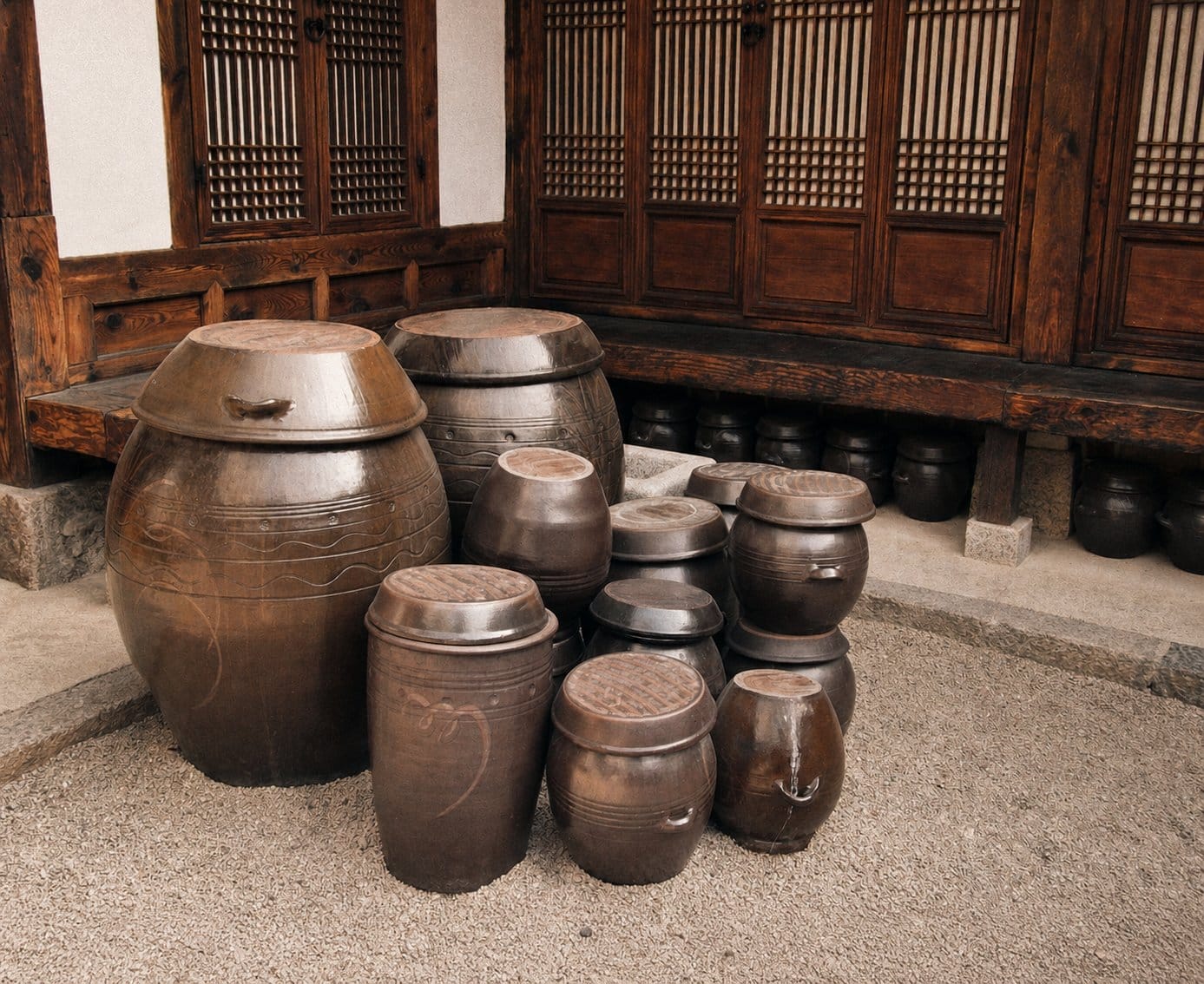
Kimchi is South Korea's most iconic food — fermented napa cabbage seasoned with gochugaru (red chili flakes), garlic, ginger, and jeotgal (fermented seafood) — and its cultural significance extends far beyond the dinner table. The flavor of kimchi deepens over weeks to months as fermentation continues, producing the characteristic tang and complexity that distinguishes well-aged kimchi from a freshly made batch. The collective practice of making kimchi, known as Kimjang, was inscribed on UNESCO's Representative List of Intangible Cultural Heritage of Humanity in 2013, recognized not simply as a food tradition but as a community bonding practice and vehicle for intergenerational knowledge transfer. As of 2025, kimchi is exported to a record 93 countries, with the fastest growth in North America and Europe, where it is positioned as a probiotic health food.
The Kimjang cycle follows the agricultural calendar precisely. Spring involves procuring seafood for fermented anchovy paste and oysters. Summer is the season for acquiring sea salt and allowing red chili peppers to dry under long daylight hours. The main Kimjang gathering happens in late autumn — families and neighbors assembling to salt the cabbage, prepare the seasoning paste, and pack kimchi into large ceramic onggi pots or, in modern homes, dedicated kimchi refrigerators. The communal scale of Kimjang is significant: in traditional rural communities, entire neighborhoods would pool labor and resources, with the finished kimchi shared among all participants.
"Kimjang reaffirms Korean identity and creates an opportunity for strengthening co-operation and solidarity among community members." — UNESCO Intangible Cultural Heritage Committee, 2013 inscription record
Kimchi is not a single dish but a family of fermented vegetables with dozens of regional and seasonal varieties. The most common — baechu kimchi — uses napa cabbage, but visitors unfamiliar with or sensitive to spice have clearly accessible alternatives. Kkakdugi is made from cubed daikon radish and carries a satisfying crunch alongside moderate heat. Mul-kimchi (water kimchi) is a lightly fermented, mildly flavored vegetable brine that is nearly entirely non-spicy. Baek kimchi (white kimchi) omits gochugaru entirely, offering a clean, tangy flavor accessible to those avoiding heat. These varieties frequently appear as banchan in restaurants without requiring a special request, making them practical options for visitors who want to experience fermented Korean food without navigating high spice levels.
| Kimchi Variety | Main Ingredient | Spice Level | Flavor Profile |
|---|---|---|---|
| Baechu Kimchi | Napa cabbage | Medium–High | Tangy, pungent, deeply complex |
| Kkakdugi | Cubed daikon radish | Medium | Crunchy, slightly sweet, spiced |
| Mul-kimchi | Mixed vegetables in brine | None–Mild | Light, refreshing, lightly fermented |
| Baek Kimchi | Napa cabbage (no chili) | None | Clean, tangy, mild |
| Oi Sobagi | Stuffed cucumber | Medium | Crisp, bright, lightly spicy |
Iconic Dishes: Bibimbap, Bulgogi, and Korean BBQ
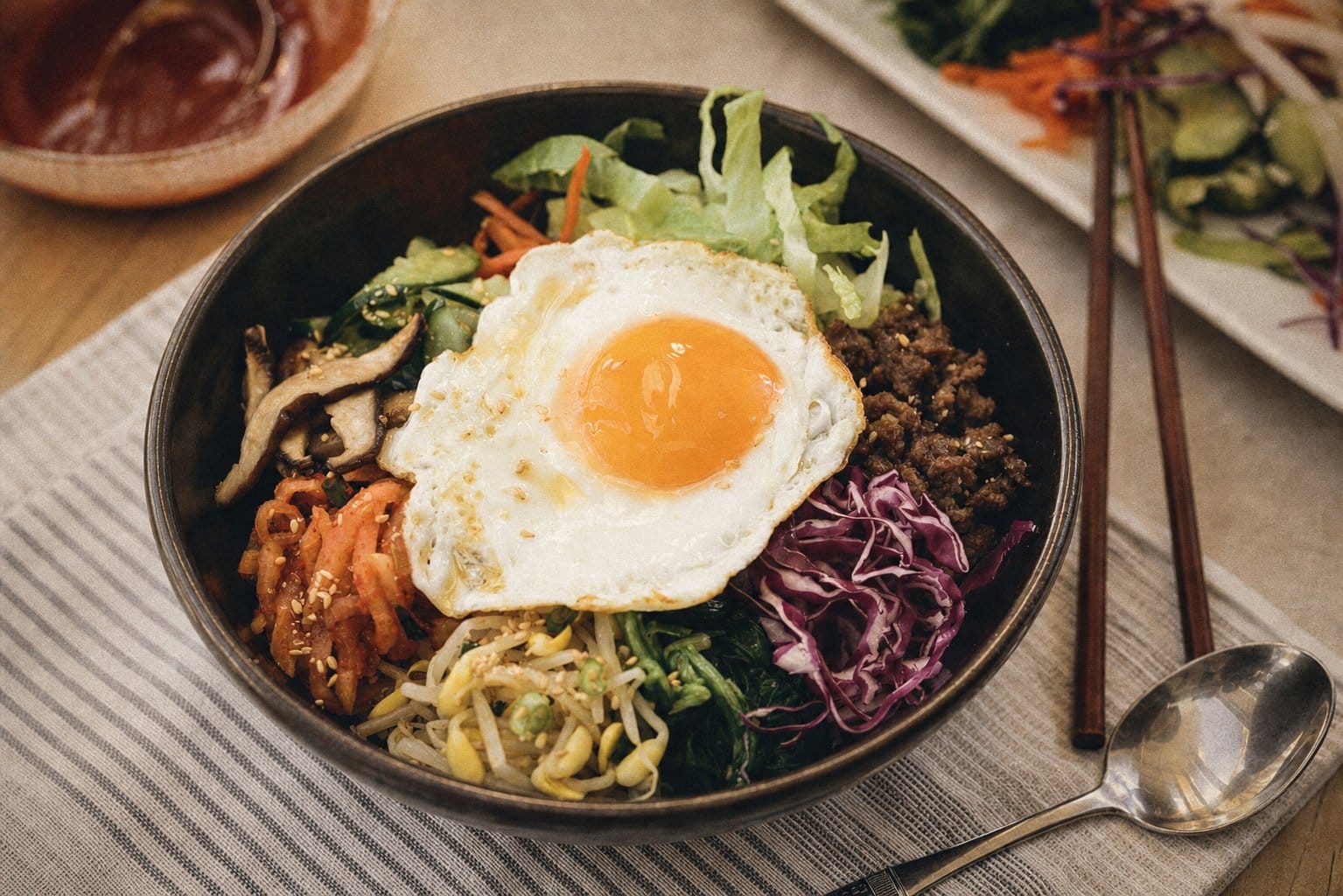
Three dishes serve as entry points into Korean cuisine for most international visitors, each embodying the communal, participatory spirit that defines how Koreans eat. Bibimbap — literally 'mixed rice' — is a warm bowl of steamed rice topped with individually seasoned namul vegetables (spinach, beansprouts, mushrooms, zucchini), a fried or raw egg, and a dollop of gochujang (red chili paste). According to Visit Korea, bibimbap is considered the dish that most fully embodies Korean cuisine's 'culture of mixing' — the act of stirring all components together before eating is integral to the dish, not optional. Bulgogi — 'fire meat' — features thinly sliced beef marinated in soy sauce, sesame oil, sugar, and Asian pear (which acts as a natural tenderizer), then grilled at high heat to produce caramelized edges and a lightly sweet, smoky result. Samgyeopsal — unmarinated pork belly grilled tableside and wrapped in fresh lettuce with ssamjang paste — rounds out the trio as the most everyday of the three.
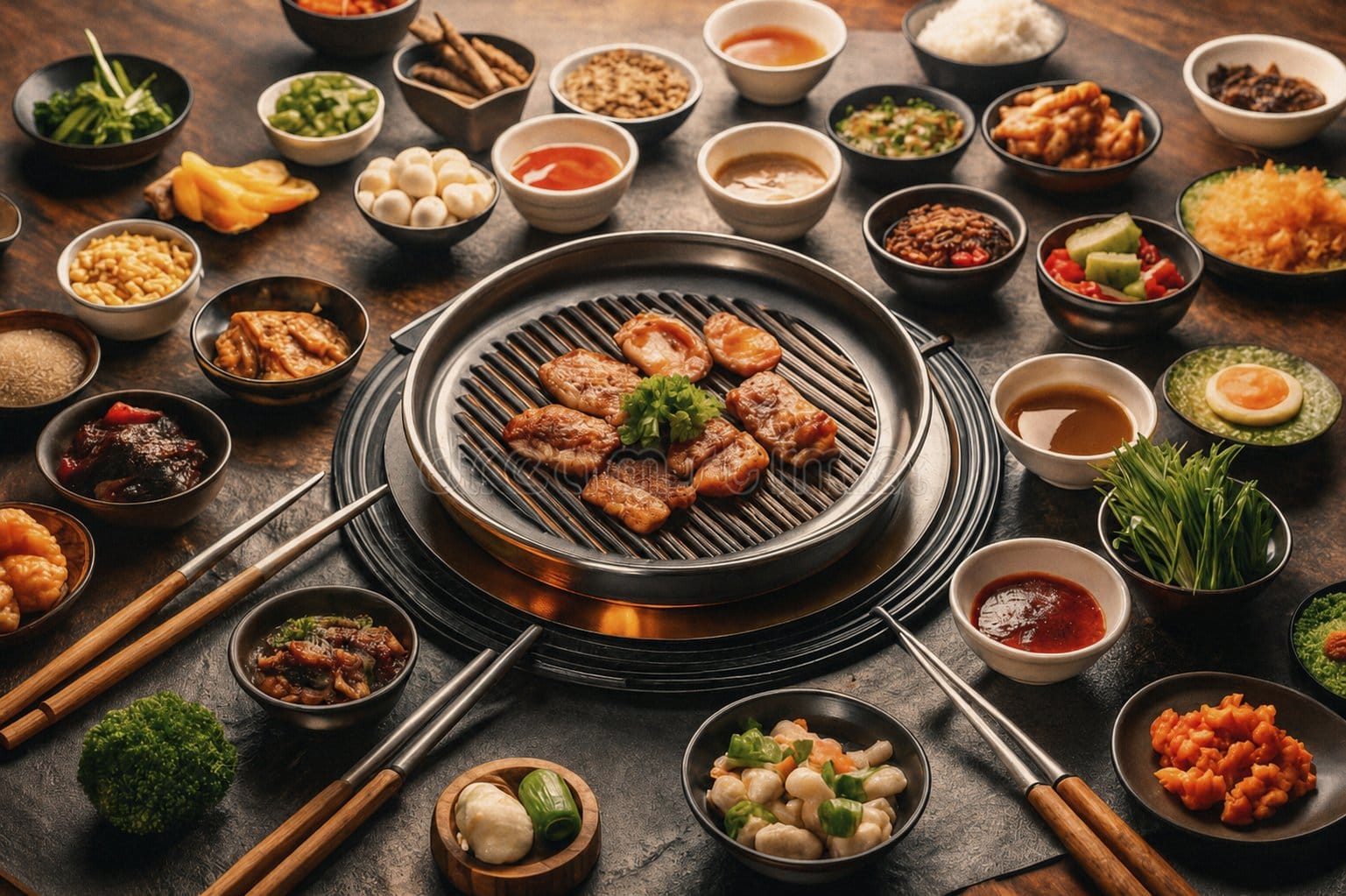
Samgyeopsal occupies a particular place in Korean food culture: it is the meal eaten after work, at gatherings with friends, and at late-night social occasions following concerts or events. Visit Korea describes it as the 'people's food' — affordable, widely available, and requiring no culinary expertise to enjoy. The tableside grill (usually charcoal or gas) arrives hot, and at many restaurants the server will cut the pork belly into bite-sized pieces using scissors — a common and practical approach. The assembly is then left to diners: place a piece of cooked pork on a fresh lettuce or perilla leaf, add ssamjang paste, a slice of raw garlic, a sliver of kimchi, fold the leaf around the filling, and eat in one bite.
"Samgyeopsal is the 'people's food' — ubiquitously available in restaurants across the country, enjoyed by every generation." — Visit Korea, Korea Tourism Organization
The DIY assembly element present in all three dishes — stirring bibimbap at the table, wrapping samgyeopsal in lettuce, customizing the dipping sauces for bulgogi — is not incidental. It reflects a broader Korean dining philosophy in which preparation and eating are participatory acts shared among everyone at the table. Unlike cuisines where dishes arrive fully composed and individually portioned, Korean food is designed to be built, adjusted, and enjoyed collectively. For K-POP fans visiting concert venues in Seoul or Busan, a post-show samgyeopsal dinner is a natural fit: accessible, sociable, and inexpensive enough that the whole group can participate regardless of appetite or budget.
Soups, Stews, and Noodle Dishes to Know
Korean cuisine features an extraordinary breadth of soups and stews — not side dishes, but dishes central to the meal in their own right. Two everyday staples anchor this category: kimchi jjigae, a tangy, deeply spiced stew of aged kimchi, tofu, and pork or tuna served bubbling in a stone pot; and sundubu-jjigae, a silky soft tofu stew in a spicy anchovy or seafood broth, also served in a stone pot so hot that an egg cracked in at the table continues cooking as you eat. Both are present on virtually every Korean restaurant menu and represent the kind of affordable, deeply satisfying cooking that defines daily Korean dining. Samgyetang — a whole young chicken stuffed with ginseng, glutinous rice, garlic, and jujube, simmered for hours until the broth turns creamy — is consumed especially in summer as a restorative against heat fatigue, according to Joy of Korean.
The logic behind eating hot soup in summer — a practice that surprises many first-time visitors — is rooted in the Korean concept of yi yeol chi yeol: fighting heat with heat. Samgyetang restaurants see their longest queues during the three hottest days of the lunar calendar (Chobok, Jungbok, and Malbok). Seolleongtang, by contrast, is a milky ox-bone broth simmered until ivory-white, seasoned at the table with salt and chopped scallions. It is one of the most accessible soups for visitors avoiding spice, as it arrives completely unseasoned and diners control the flavor entirely themselves. Gamjatang — a spicy pork neck and potato soup — serves a different social role: it is a popular late-night and post-drinking comfort dish, particularly at 24-hour restaurants in areas like Hongdae or Itaewon.
In the noodle category, japchae — glass noodles made from sweet potato starch, stir-fried with vegetables and seasoned with soy sauce and sesame oil — has traveled from the royal court to every celebration table in Korea. It appears at birthdays, weddings, and holiday feasts as a matter of cultural expectation, and is inherently non-spicy. Naengmyeon — thin buckwheat noodles served in icy beef or dongchimi broth — is a summer specialty with roots in the Pyongyang tradition, frequently eaten after a Korean BBQ meal as a cooling, palate-clearing finish. Jjajangmyeon (noodles in black bean paste sauce) represents Korea's most beloved culinary adaptation: a Korean-Chinese fusion dish so deeply embedded in delivery culture and K-drama food scenes that international fans often recognize it immediately from its distinctive dark, glossy appearance on screen.
For visitors navigating menus, a practical note: stews like kimchi jjigae and sundubu-jjigae are ordered and served per person. Soups like seolleongtang and samgyetang come as single-serve bowls. Noodle dishes are generally individual portions, though a jjajangmyeon alongside a full Korean BBQ spread is a common group dining combination in casual settings.
Seoul Street Food: Gwangjang Market, Myeongdong, and Namdaemun
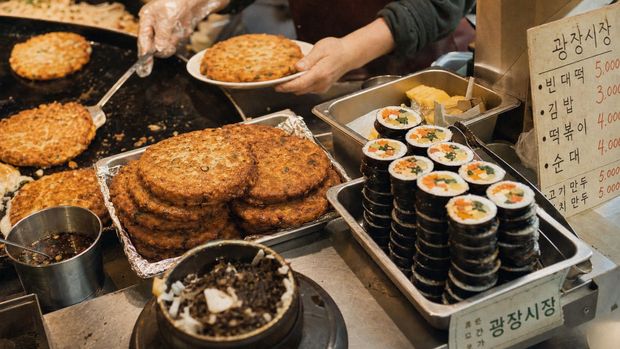
Seoul's street food scene is one of the city's most immediately accessible attractions, concentrated in three distinct areas that each offer a different atmosphere and food focus. Tteokbokki — chewy cylindrical rice cakes cooked in a spiced gochujang sauce — is the defining Korean street snack, available at virtually every food stall across the city. A 2026 trend variation called 'Rose Tteokbokki' adds a creamy, carbonara-style sauce to the base, cutting the heat with dairy richness and producing a visually striking pink-orange dish that has spread through social media and stall menus with notable speed. Gimbap — seaweed-wrapped rice rolls filled with egg, pickled radish, spinach, and meat — is portable and affordable across all market zones, seasoned with sesame oil rather than vinegar and constructed with savory rather than raw-fish-forward fillings, making it distinct from Japanese maki in both flavor and composition.
Gwangjang Market | 광장시장
Gwangjang Market in Jongno is one of Seoul's oldest covered markets and a well-established food destination known particularly for bindaetteok (crispy mung bean pancakes fried on large griddles) and yukhoe (raw beef tartare seasoned with sesame oil, Asian pear, and pine nuts). The covered market hall provides shelter from rain or summer heat. Seating is communal — long shared benches at each vendor's stall — and ordering is done by pointing at the food or making eye contact with the vendor. The market is accessible via Seoul Metro Line 1 (Jongno 5-ga Station) or Line 2 and 5 (Euljiro 4-ga Station). The food section is most active from late morning through early evening.
📍 88 Cheonggyecheon-ro, Jongno District, Seoul
🕒 Daily 9:00 AM – 10:30 PM
⭐ 4.2 (43,859 reviews)
📞 02-2267-0291
🔗 View on Google Maps
Myeongdong | 명동
Myeongdong is Seoul's most tourist-accessible street food corridor: a dense open-air shopping and dining stretch where stall vendors line both sides of the main street from mid-afternoon into the late evening. The stall variety rotates with trends and seasons, but regulars include tteokbokki, gimbap, hotteok (sweet syrup pancakes), skewered meats and vegetables, tornado potato, and egg bread. The area is easy to navigate without Korean language skills — many vendors use visual menus and are accustomed to international visitors. Most servings are priced in a very affordable range. Myeongdong is accessible via Seoul Metro Line 4 (Myeongdong Station).
📍 Myeong-dong, Jung District, Seoul
🔗 View on Google Maps
Namdaemun Market | 남대문시장
Namdaemun Market, Korea's largest traditional market, draws a more local crowd than Myeongdong and offers a broader mix of food, wholesale goods, and everyday commerce. The food section near Gate 2 is particularly known for hotteok — sweet pancakes filled with cinnamon syrup, brown sugar, and crushed nuts. A newer variant, Japchae Hotteok, stuffs the pancake with seasoned glass noodles instead, producing a savory-sweet hybrid that has become a signature of the area. Fish cake skewers (odeng/eomuk) served with free warm broth are another Namdaemun staple. The market is accessible via Seoul Metro Line 4 (Hoehyeon Station).
📍 21 Namdaemunsijang 4-gil, Jung District, Seoul
🕒 Monday–Saturday 9:00 AM – 5:00 PM / Sunday Closed
⭐ 4.2 (28,123 reviews)
📞 02-753-2805
🔗 View on Google Maps
How Hallyu Spread Korean Food Worldwide
Korean food's global expansion is directly traceable to the Hallyu (Korean Wave) — the international spread of K-pop, K-dramas, and Korean cinema that accelerated sharply through the 2020s. Food scenes in K-dramas and K-pop music videos — chimaek (fried chicken paired with beer), instant ramen eaten late at night, tteokbokki shared between characters at pojangmacha street stalls — generated measurable international curiosity and purchase intent that Korean food export data now confirms at scale. Korea's Culture Ministry reported that online mentions of 'K-culture' increased 31% in 2025 versus 2024, a figure that tracks directly with the volume of Korean content reaching global streaming audiences. The pathway from watching a food scene in a K-drama to searching for the dish in a local supermarket has become measurably short, and the industry numbers reflect that consumer behavior at scale.
The export figures are significant and growing. K-Food Plus exports reached USD 3.18 billion in Q1 2025 alone, up 7.9% year-over-year, and USD 6.67 billion across the first half of 2025, up 7.1%. South Korea's instant noodle (ramyeon) exports hit a record USD 1.52 billion in full-year 2025, growing 21.8% annually. Exports to the United States rose 28.6% year-over-year in Q2 2025, reaching USD 493.7 million. South Korea has set a national target of USD 16 billion in K-food exports.
"Four product categories — ramyeon, kimbap, tteokbokki, and Korean BBQ — are the primary drivers of K-food's global expansion." — SeoulZ, K-Food Global Market Report 2026
| K-Food Export Metric | Figure | Period | YoY Growth |
|---|---|---|---|
| Total K-Food Plus exports | USD 3.18 billion | Q1 2025 | +7.9% |
| Total K-Food Plus exports | USD 6.67 billion | H1 2025 | +7.1% |
| Ramyeon (instant noodle) exports | USD 1.52 billion | Full year 2025 | +21.8% |
| Exports to United States | USD 493.7 million | Q2 2025 | +28.6% |
| Countries receiving kimchi exports | 93 countries | 2025 | Record high |
| National K-food export target | USD 16 billion | Government target | — |
The Korean government's K-Food branding campaigns have been active in North America, Europe, and Southeast Asia, positioning Korean cuisine alongside Japanese and Chinese food as a global culinary tier rather than a niche category. Gochujang, kimchi kits, and instant tteokbokki are among the fastest-growing items in Western supermarkets, with dedicated Korean food sections now common in major retail chains across North America, the UK, and Japan. For K-POP fans, the Hallyu food connection is particularly concrete: when an idol posts about a dish, or when a K-drama features a prolonged cooking scene, search volume for that dish spikes within hours — a pattern the Korean food industry has recognized and is actively building distribution capacity to serve.
Dining Etiquette and Practical Tips for Visiting Fans
Navigating a Korean restaurant for the first time is straightforward once a few practical norms are understood. Most casual restaurants now offer photo menus or QR code menus with at least basic English, particularly in tourist-frequented areas of Seoul, Busan, and Gyeongju. When ready to order — or when you need anything during the meal — press the table call button (벨). Staff follow a non-intrusive service model and will not approach your table proactively, so the button is the expected method of getting attention. After the meal, payment is made at the counter near the exit, not at the table. Tipping is not practiced in Korea and is not expected; attempting to leave a cash tip may cause confusion for staff.
For visitors concerned about spice levels, the Korean phrase '맵지 않게 해주세요' (not spicy, please) is worth showing on a phone screen when ordering. Many dishes are inherently non-spicy and require no modification: seolleongtang (ox-bone broth soup, seasoned to taste at the table by the diner), japchae (glass noodles with vegetables), galbi (grilled beef short ribs), galbijjim (braised short ribs in a savory-sweet soy sauce), samgyetang (ginseng chicken soup), and most bone broth-based soups. Bibimbap can be ordered with gochujang served on the side rather than mixed in. Baek kimchi and mul-kimchi — both frequently available as banchan — are either non-spicy or very mild and provide a way to experience Korean fermentation without high heat.
Alcohol follows its own table etiquette in Korea. Soju is ordered by the bottle and shared among everyone at the table — pouring for others before yourself is the norm, and accepting the first pour from a senior person with two hands is a gesture of respect. Makgeolli (lightly fermented, milky rice wine) pairs by long tradition with pajeon (scallion pancake), a combination particularly popular on rainy evenings — an association so culturally consistent that makgeolli sales measurably rise during rainfall in Seoul. For non-drinkers, sikhye (sweet rice punch) and barley tea (boricha) are widely available as non-alcoholic alternatives at no additional cost.
Frequently Asked Questions
What is banchan and why is it refilled for free?
Banchan (반찬) are the small communal side dishes served alongside rice and soup in a Korean meal. They typically include kimchi, seasoned vegetables such as spinach or beansprouts, pickled radishes, dried fish, acorn jelly, and other preparations that vary by region and season. All banchan at the table are shared by everyone dining — there are no individual portions. Free refills throughout the meal are a standard hospitality norm in Korean dining culture, rooted in centuries of communal table tradition and embedded in how Korean restaurants operate, not a promotional offer. To request a refill, press the table call button and gesture toward the dish you want more of. There is no additional charge.
Is Korean food always spicy? What options exist for low-spice diners?
Korean food varies widely in spice level, and a substantial portion of the cuisine is either naturally mild or entirely non-spicy. Dishes with no meaningful heat include seolleongtang (ox-bone broth soup, which arrives unseasoned and is salted to taste at the table), japchae (glass noodles with stir-fried vegetables), galbi (grilled beef short ribs), galbijjim (braised short ribs in a sweet soy sauce), samgyetang (ginseng chicken soup), and most bone broth soups. Bibimbap can be ordered with gochujang served separately on the side. To request a milder preparation, show the phrase '맵지 않게 해주세요' on your phone — staff in tourist areas are familiar with the request. Banchan options like baek kimchi (white kimchi, no chili) and mul-kimchi (water kimchi) also allow visitors to explore Korean fermentation without encountering significant heat.
Why is Kimjang recognized as UNESCO Intangible Cultural Heritage?
UNESCO's 2013 inscription of Kimjang focused on the social ritual rather than the food itself. The committee recognized Kimjang as a practice that "reaffirms Korean identity and promotes solidarity and co-operation," as communities and families gather each late autumn to collectively prepare kimchi for the winter months. The practice represents a living form of intergenerational knowledge transfer — recipes, seasoning ratios, and fermentation timing passed from older to younger family members over the course of a shared day's work. UNESCO's criteria for Intangible Cultural Heritage center on community participation and living cultural expression, both of which Kimjang embodies: it continues to be practiced by millions of Korean households annually and has adapted to urban contexts through Kimjang festivals, community centers, and apartment building communal events.
Which Seoul area is most accessible for street food as a first-time visitor?
Three areas serve different visitor needs. Myeongdong is the most immediately navigable: a dense open-air corridor of food stalls running through the main shopping district, with English-friendly vendors, high foot traffic, and visual menus. It is accessible via Seoul Metro Line 4 (Myeongdong Station). Gwangjang Market in Jongno offers a covered traditional market environment with well-known bindaetteok (mung bean pancakes) and yukhoe (beef tartare); it is accessible via Line 1 (Jongno 5-ga Station). Namdaemun Market near Hoehyeon Station (Line 4) is larger and more locally oriented, with the Gate 2 food section known for hotteok and japchae hotteok. All three operate into the evening. A practical day itinerary could sequence Gwangjang → Myeongdong → Namdaemun given their geographic proximity in central Seoul.
How does Korean BBQ work for first-time visitors?
Korean BBQ restaurants center on a gas or charcoal grill set into the dining table. You order raw meat by cut — samgyeopsal (pork belly), galbi (beef short rib), chadolbaegi (thin beef brisket), or ogyeopsal (five-layer pork) are common choices — and it arrives uncooked alongside scissors, tongs, and a spread of banchan. Some restaurants have staff who grill the meat; others leave it entirely to the table. When the meat is cooked to a charred, caramelized edge, the standard approach is ssam (wrapping): place a piece of cooked meat on a fresh lettuce or perilla leaf, add a smear of ssamjang (fermented soybean and chili paste), a slice of garlic, and a piece of kimchi, then fold and eat in one bite. Sesame oil with coarse salt is a common additional dipping sauce. The meal is self-paced — there is no prescribed order, and the participatory nature of grilling and assembling is itself part of the dining experience.
Korean Food Culture: A Living Tradition Worth Exploring
Korean cuisine is not a monolithic category reducible to a single dish or trend. It is a living food culture with deep fermentation traditions, a structured communal dining logic, and an extraordinary range of dishes spanning royal court preparations, everyday street snacks, and seasonal rituals. For K-POP fans planning a visit to Korea for a concert, tour, or festival, food is rarely a logistical afterthought — the after-show samgyeopsal dinner, the market tteokbokki at midnight, and the restorative samgyetang the morning after are part of the experience that Korean content creators, fans, and the wider Hallyu ecosystem have collectively built into the culture of visiting.
The global numbers tell a parallel story: USD 6.67 billion in K-food exports in the first half of 2025 alone, kimchi reaching 93 countries, and ramyeon growing at 21.8% annually — these are not simply trade statistics but measures of cultural reach. Korean food has become a point of entry into Korean culture for millions of people who have never visited the country. For those who do visit, the reality of eating in Korea — the table bell, the free banchan refills, the communal grill, the soju poured for others before yourself — is both more practical and more richly layered than any supermarket product can convey.
Whether navigating Gwangjang Market before a Seoul concert or ordering kimchi jjigae at a neighborhood restaurant in Hongdae, the fundamentals here provide a working framework. Korean food culture rewards engagement: ask what the daily soup is, try the banchan you cannot identify, and press the 벨 when you want more.
Last updated: 2026-05-17. This article draws on Korean government export data, UNESCO documentation, and on-the-ground food reporting current as of May 2026. Export statistics are reviewed and updated annually as new government briefing data becomes available.
Related Articles
- 首尔街头美食市场与街区饮食指南:2026年版
- ソウルのストリートフード市場と街ごとのグルメガイド:2026年版
- 서울 길거리 음식 시장과 동네 맛집: 2026 가이드
- Seoul Street Food Markets & Neighborhood Eats: 2026 Guide
- 韩国文化概览:历史、语言、美食与韩流
This article was written using information collected and analyzed by NAMANE's in-house K-pop research AI engine. We use AI technology to bring you faster, broader coverage, and in the process some details may occasionally differ from the latest facts. For important information such as dates, venues, and prices, please double-check with official sources.


