
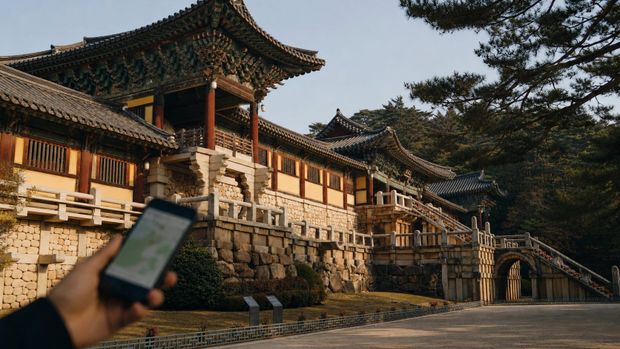
Getting Around Southern Korea: KTX, Rail Passes, and Local Transport
South Korea's KTX high-speed rail network makes southern Korea accessible from Seoul in timeframes that support multi-city itineraries without domestic flights. KTX services from Seoul reach Singyeongju station — the high-speed stop serving Gyeongju — in approximately two hours on the Gyeongbu high-speed line, with multiple daily departures. Direct KTX services to Jeonju operate on the Honam high-speed line in approximately one hour and fifty minutes from Seoul or Yongsan station. Gwangju is accessible in approximately one hour and forty-five minutes via Gwangju Songjeong station, and Yeosu EXPO station — the KTX terminus for the South Sea coast — is approximately two hours and forty minutes from Seoul on the Jeolla line. For travelers combining multiple southern destinations, KORAIL's Korea Rail Pass (KORAIL Pass), available exclusively to foreign passport holders, offers significant cost savings over point-to-point ticket purchasing and can be acquired through KORAIL's international booking portal or authorized overseas rail agents before departure. The pass is available in 2-day, 3-day, 5-day, and flexible configurations, and covers KTX, ITX, and standard express services across the entire national network.
| Route | Seoul Departure Station | Arrival Station | Approx. Travel Time | Rail Line |
|---|---|---|---|---|
| Seoul → Gyeongju | Seoul Station | Singyeongju | ~2 hours | Gyeongbu High-Speed |
| Seoul → Jeonju | Yongsan / Seoul Station | Jeonju | ~1h 50min | Honam High-Speed |
| Seoul → Gwangju | Seoul Station | Gwangju Songjeong | ~1h 45min | Honam High-Speed |
| Seoul → Yeosu | Yongsan Station | Yeosu EXPO | ~2h 40min | Jeolla Line |
| Busan → Gyeongju | Busan Station | Singyeongju | ~25–30 min | Gyeongbu High-Speed |
| Jeonju → Gwangju | Jeonju Station | Gwangju Songjeong | ~40–50 min | Honam High-Speed |
Local transport within each city follows distinct patterns worth planning around before arrival. Gyeongju's heritage sites are distributed across a wide area and are most efficiently covered by rental bicycle — the city has invested in cycling infrastructure specifically for heritage route tourism — or by local tourist bus along routes designed for the main monument circuit. Jeonju Hanok Village sits within comfortable walking distance of Jeonju KTX station (approximately 15 minutes through the city center), making it one of the most walkable KTX-accessible heritage districts in Korea; no taxi or additional transit is needed between the station and the hanok quarter. In Gwangju and Yeosu, city buses and taxis cover the main visitor sites reliably. Both cities also have domestic airports — Gwangju Airport and Yeosu Airport — that handle flights from Seoul Gimpo, providing a practical option for travelers who prefer to anchor one end of their itinerary by air or who plan to extend south to Jeju Island from the mainland coast. Domestic flight booking for these routes is straightforward through Korean carriers and typically available with short advance notice.
Regional Economy and the 2026 Administrative Landscape
Southern Korea's economic profile in 2026 is shaped by a combination of global trade headwinds, domestic administrative restructuring, and a tourism revenue surge that is injecting new cash flows into regions historically dependent on export manufacturing. At the national level, South Korea's GDP is projected to grow 2.1% in 2026, recovering from a politically turbulent 2025 that produced only 1.0% growth, according to analysis by the Korea Economic Institute of America (KEIA). Unemployment sits near historically low levels at approximately 2.5%, and the Bank of Korea reduced its policy rate by 50 basis points in 2025 to 2.5% to support recovery. Export headwinds are significant, however: U.S. tariffs on Korean goods rose to an effective 16% in early 2025, and Korea's three largest trading partners — China, the United States, and Japan — are all facing slower growth in 2026. Export growth is projected to slow to 3.6% for the year, down from 6.8% in 2024.
Busan's port, ranked sixth-busiest globally by container throughput, remains the southeastern coast's primary economic anchor. Port operations underpin a regional economy spanning shipbuilding, automotive manufacturing, and petrochemicals across the Ulsan and South Gyeongsang corridor. Discussions about merging Busan, Ulsan, and South Gyeongsang Province into a "Bu-Ui-Gyeong" megacity have resurfaced in 2026, as the Korea Times reports, but local governments are insisting on public referendums before any integration proceeds, citing unresolved questions from prior rural-urban merger experiences. If enacted, the proposal would create a southeastern economic zone with a combined population of approximately 7.7 million — comparable in scale to major metropolitan regions in Japan and Taiwan.
"South Korea's GDP growth is projected at 2.1% for 2026, supported by domestic demand recovery and tourism revenue gains — but the export outlook remains constrained by U.S. tariff pressures and slowing growth among Korea's primary trading partners." — Korea Economic Institute of America (KEIA), 2026 Economic Outlook Analysis
The Gwangju–South Jeolla merger, formalizing on July 1, 2026, introduces a different economic calculus for the historically lower-growth southwest. The restructuring unlocks up to 5 trillion won (approximately $3.45 billion) annually for up to four years from the central government — with fiscal autonomy equivalent to Seoul Metropolitan Government — earmarked for renewable energy grid infrastructure, electricity-sector industrial development, and metropolitan transport improvements. Tourism spending exceeded 3 trillion won in Q1 2026 alone, a meaningful revenue injection for regions whose export-dependent manufacturing bases face mounting external pressure. For the broader Jeolla economy, the merger's administrative consolidation and investment commitment represent a concerted effort to accelerate growth in a region that has consistently trailed Korea's southeastern industrial corridor on per-capita output metrics.
Sample Southern Korea Itineraries: 5-Day and 7-Day Routes
Southern Korea's KTX connectivity supports two practical itinerary formats for international visitors combining heritage, gastronomy, and cultural sites: a five-day southeastern-and-Jeolla loop, and a seven-day extension adding full Jeolla coast coverage. Both are structured around KTX rail travel, with Busan as the logical international arrival point for visitors flying into Gimhae International Airport from major hub cities across Asia, the United States, or Europe.
The five-day route runs: Busan (2 nights) → Gyeongju (1 night) → Jeonju (1 night) → Seoul. Busan provides the southeastern anchor — Haeundae Beach, Jagalchi Fish Market, and Gamcheon Culture Village cover two full days comfortably — while Gyeongju's heritage circuit (Bulguksa, Tumuli Park, Seokguram) fills a single full day with early-morning and late-afternoon visits. Jeonju's hanok village and culinary trail occupies the fourth day, with an evening KTX return completing the loop to Seoul. The Busan-to-Gyeongju KTX leg takes approximately 25–30 minutes — the easiest inter-city transition on the route. The seven-day extension adds Gwangju (1 night) → Yeosu (1 night) after Jeonju, via KTX branches on the Honam and Jeolla lines. The Asia Culture Center and May 18th National Cemetery anchor the Gwangju day, while Yeosu's scenic bay, marine cable car, and seafood dining district provide a natural itinerary closer before the return north.
Seasonal timing shapes the experience meaningfully across all stops. Gyeongju's cherry blossoms peak late March through mid-April, and the Cherry Blossom Festival concentrates visitor activity during this window — advance accommodation booking is strongly advisable. Jeonju's major events cluster in late April to early May (Bibimbap Festival) and October (International Fermented Food Expo). Autumn foliage at Bulguksa and in the Jirisan National Park area runs through late October, offering some of the most photographed seasonal scenery in southern Korea. Accommodation options span hanok guesthouses in Jeonju — which offer traditional-stay immersion and fill quickly during festival periods — to international hotel inventory in Gwangju and Gyeongju for travelers who prefer standard amenities.
Frequently Asked Questions
How do I travel from Seoul to Gyeongju and Jeonju by train?
From Seoul, KTX high-speed rail reaches Singyeongju station — the main KTX stop serving Gyeongju — in approximately two hours on the Gyeongbu high-speed line. From Singyeongju, Gyeongju city center and major heritage sites are accessible by local bus or taxi in 15–20 minutes. KTX services to Jeonju operate on the Honam high-speed line with a direct journey time of approximately one hour and fifty minutes from Seoul or Yongsan station. For travelers visiting both cities as part of a multi-stop southern itinerary, the KORAIL Pass (Korea Rail Pass) — available exclusively to foreign passport holders — offers significant cost savings over purchasing individual point-to-point tickets and can be bought in advance online through KORAIL's international platform. Once in Gyeongju, rental bicycles are the recommended way to cover the city's distributed heritage sites; Jeonju Hanok Village is walkable from Jeonju KTX station in approximately 15 minutes, so no additional local transport is needed to reach the main visitor area.
Why is Jeonju recognized as a UNESCO Gastronomy City?
Jeonju received its UNESCO Creative City of Gastronomy designation in 2012, recognizing both the depth of its culinary heritage and its active institutional investment in transmitting that heritage. The city is widely recognized as the birthplace of bibimbap and draws its food identity from three interlocking local ingredient sources: rice from the Honam Plain, seafood and salted fish from the Yellow Sea coast, and wild mountain vegetables from the surrounding Jeolla highlands. These ingredients feed into centuries-old fermentation traditions — kimchi varieties, jangs (fermented pastes), and preserved vegetables — that form the functional base of Jeolla-style Korean cuisine. Institutional infrastructure supporting the designation includes the Creative Culinary Institute of Korea and the Bibimbap Globalization Foundation, both headquartered in Jeonju. The annual Jeonju Bibimbap Festival and International Fermented Food Expo anchor the city's culinary tourism calendar each spring and autumn respectively.
What is the Bu-Ui-Gyeong megacity proposal?
The Bu-Ui-Gyeong proposal is a plan to merge Busan Metropolitan City, Ulsan Metropolitan City, and South Gyeongsang Province into a unified southeastern administrative region. The combined jurisdiction would encompass approximately 7.7 million residents and function as South Korea's second major administrative mega-region after the greater Seoul metropolitan area. Discussions around the proposal have resurfaced in 2026, according to the Korea Times, but local governments in all three jurisdictions are insisting on public referendums before any formal integration proceeds, citing concerns from prior rural-urban merger experiences. The initiative is part of the current administration's "5 mega-regions, 3 special provinces" regional development framework, which frames administrative consolidation as a tool for balanced national growth — though critics have questioned whether the timing reflects political calculation as much as regional planning logic.
Is the southern region of South Korea worthwhile for K-pop fans?
Yes. Jeonju Hanok Village appears in multiple major K-drama productions and functions as a well-established fan pilgrimage destination — the visual settings map directly onto a walkable heritage district accessible by KTX in under two hours from Seoul. Gyeongju's historical landscapes appear regularly in sageuk (historical drama) productions, drawing fans seeking on-location immersion in settings they recognize from screen. Busan, South Korea's second-largest city and a major KTX hub, hosts large-scale concerts and maintains an established live performance infrastructure that makes it a viable concert destination alongside Seoul. Arts festivals in Gwangju — including the Gwangju Biennale and programming at the Asia Culture Center — extend the cultural circuit for fans whose interests span the broader creative industries that hallyu represents. Fan travel patterns increasingly combine Seoul or Busan concert stops with multi-day southern itineraries that treat heritage and cultural sites as natural extensions of the same trip.
When is the best season to visit Gyeongju?
Gyeongju has two strong travel seasons. Spring — specifically late March through mid-April — brings the annual Cherry Blossom Festival, during which the city's cycling paths, Tumuli Park, and the approach to Bulguksa Temple are lined with flowering cherry trees. This is the city's peak domestic travel period, and accommodation books out quickly during festival weekends. Autumn — primarily October — offers cooler temperatures, fall foliage at Bulguksa and along surrounding mountain trails including Namsan, and lower overall visitor density than spring. Early-morning visits to both Tumuli Park and Bulguksa are advisable year-round: morning light and minimal tourist foot traffic make these the most atmospheric times to experience either site. Summer (July–August) is manageable but humid; winter visits are quiet, with the advantage of near-empty heritage grounds and occasional frost that transforms the tumuli landscape into something quite different from its spring appearance.
Planning a Southern Korea Visit: Putting It Together
Southern Korea in 2026 presents a coherent and increasingly well-connected travel proposition — particularly for international visitors arriving with cultural motivations rooted in K-drama, K-pop, or Korean cuisine. The tourism data confirms the region is capturing a growing share of inbound traffic, with non-Seoul airport arrivals up nearly 50% year-on-year. That shift reflects both improved rail connectivity and a broadening in how hallyu-motivated travelers engage with the country: moving from single-city concert visits toward multi-stop itineraries that pair contemporary cultural events with the historical settings those events reference and draw from.
Gyeongju, Jeonju, and Gwangju each offer a distinct cultural register. Gyeongju's Silla heritage is immersive in a way that no reconstructed setting can replicate — the burial mounds and Buddhist temples are the landscape, not artifacts within it. Jeonju's hanok district and UNESCO-recognized food culture create a pairing of architecture and gastronomy that rewards slow travel and multiple days rather than a rushed half-day stop. Gwangju's democratization history and contemporary arts scene give the city intellectual and civic depth that distinguishes it from standard heritage tourism circuits. The KTX network connecting all three cities keeps the practical barriers to a multi-city southern itinerary well within reach of any independent rail traveler.
Administrative changes in 2026 — the Gwangju–South Jeolla Special City launch and the ongoing Bu-Ui-Gyeong discussions — signal a region in active economic restructuring, with substantial central government investment flowing into infrastructure and industry. For visitors, the near-term consequence is improved transport connectivity and a growing accommodation supply in cities actively investing in their international visitor capacity. The southern regions are not a detour from Korea's main travel circuit anymore; the data, the infrastructure, and the cultural programming are all pointing in the same direction.
Last updated: 2026-05-11. Article reviewed using Q1 2026 arrival statistics from MICE Travel Advisor, OECD and Korea Economic Institute of America economic projections, UNESCO Creative Cities Network records, and Korea Herald and Korea Times reporting on regional administrative developments, current as of May 2026.


