
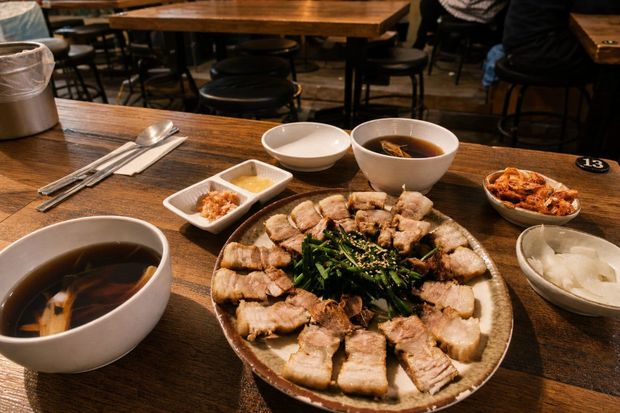
Seoul's Food Map: What Each Neighborhood Offers
Seoul's food map is organized by neighborhood, and each district carries a distinct character shaped by who lives, works, and eats there. Mapo and Sangam, residential areas west of the Han River, house smoke-stained Korean BBQ joints frequented by locals — pricing reflects the neighborhood economy rather than tourist foot traffic, and the clientele is overwhelmingly Korean. Hongdae, anchored by Hongik University, runs on chimaek culture (fried chicken and beer), budget Korean comfort food, and a university-crowd energy that keeps kitchens open past midnight. Gangnam, south of the river, holds Seoul's highest concentration of fine-dining establishments — according to Stars and Stripes Korea, six Seoul restaurants appeared on Asia's 50 Best 2026, and the majority are Gangnam-based. Jongno and Insadong anchor the historic core, with century-old institutions, traditional one-bowl meals, and direct access to Gwangjang Market near the major palace districts. Choosing where to eat in Seoul is, in large part, choosing which version of the city you want to inhabit for the evening.
Quick Answer: Seoul's food scene divides by neighborhood: Mapo for local-priced charcoal BBQ, Hongdae for late-night chimaek, Gangnam for fine dining (six restaurants on Asia's 50 Best 2026), and Jongno/Insadong for historic one-bowl meals. Budget ₩20,000–60,000 for a mid-range meal for two; fine dining runs ₩150,000–300,000 per person.
Mapo and Sangam reward travelers willing to cross the river from the tourist corridors. This is where Seoul's working professionals eat samgyeopsal after long shifts — the ventilation hoods are smoke-stained because they have been absorbing charcoal fumes for decades, not because of interior design choices. According to MileAsia, Mapo and Sangam consistently offer the city's most accessible Korean BBQ pricing, with minimal tourist markup. The neighborhoods sit adjacent to World Cup Stadium and mid-rise residential blocks, meaning the customer base is overwhelmingly local.
Hongdae operates on a different clock. The area near Hongik University Station (Line 2) stays active until 2 or 3 AM on weekends, with chimaek restaurants, ramyeon bars, and 24-hour kimbap shops absorbing foot traffic long after Gangnam has gone quiet. The food quality is reliable rather than exceptional — this is comfort eating and budget eating — but the energy and price point make it a practical base for travelers staying in the area. Street food alleys near Exit 9 of Hongik University Station concentrate the best of the late-night options, including tteokbokki and hotteok stalls.
Jongno and Insadong carry the city's culinary history. Imun Seolnongtang (established 1904) and Hadongkwan (established 1939) both operate here, among Korea's oldest continuously running restaurants. Dining culture in this area skews toward single-dish lunch meals eaten by office workers and older regulars, with prices that remain modest partly because the local clientele expects it. Gwangjang Market, founded in 1905 near Jongno 5-ga Station, anchors the neighborhood's food experience with bindaetteok, mayak gimbap, and yukhoe stalls that have been in operation across generations, as documented by Will Fly for Food.
| Neighborhood | Food Character | Price Range (per person) | Best For |
|---|---|---|---|
| Mapo / Sangam | Local charcoal BBQ, samgyeopsal, gopchang | ₩15,000–30,000 | Korean BBQ without tourist markup |
| Hongdae | Chimaek, ramyeon, late-night street food | ₩8,000–20,000 | Budget eating, late-night options |
| Gangnam | Michelin dining, upscale bibimbap, refined Korean | ₩30,000–300,000+ | Fine dining, Asia's 50 Best restaurants |
| Jongno / Insadong | Seolnongtang, gomtang, traditional one-bowl meals | ₩10,000–20,000 | Historic restaurants, Gwangjang Market access |
| Myeongdong | Evening street food, tourist-facing restaurants | ₩5,000–25,000 | Street snacks; avoid sit-down BBQ here |
| Itaewon | International cuisine, Korean fusion | ₩15,000–40,000 | Non-Korean food days, diverse options |
Historic Seoul: Restaurants That Have Been Open for Decades
Seoul's oldest continuously operating restaurants share a common logic: they found one dish worth perfecting and did not stray from it. Imun Seolnongtang, established in 1904 near Jonggak Station on Line 1, is Korea's oldest operating restaurant — a single-room establishment serving ox-bone soup (seolnongtang) daily from 8 AM to 9 PM. The broth runs milky white from hours of simmering, and the menu has not expanded significantly in over a century. Hadongkwan, opened in 1939 in Myeongdong, specializes in gomtang — a cleaner, more refined beef-bone soup — and operates only from 7 AM to 4:30 PM; it routinely sells out well before closing, as documented by Will Fly for Food. Tosokchon, near Gyeongbokgung Palace, has been serving samgyetang (ginseng chicken soup) for more than 30 years and draws year-round queues from both locals and visitors.
The longevity of these restaurants signals something specific about Seoul's dining culture. Each maintains a consistent single-dish focus — no seasonal menus, no limited-time items, and no attempt to reinvent the experience for each new generation of diners. Their regulars are neighborhood loyalists who have been returning for decades, and the pricing reflects that relationship. A bowl of seolnongtang at Imun Seolnongtang costs around ₩10,000–12,000; gomtang at Hadongkwan is comparable. These are not museum pieces — they are functioning lunch spots for the surrounding community, which is precisely what keeps the food consistent.
"Seoul's most enduring restaurants succeed because they resist the temptation to expand their menu or modernize for trend cycles — their value lies precisely in doing the same thing, correctly, every single day," — ZenKimchi, one of Seoul's longest-running English-language food resources, on the city's century-old dining institutions (source: ZenKimchi).
Tosokchon deserves a separate note. Located on a side street between Gyeongbokgung Palace and the former presidential residence, its reputation for samgyetang — a whole small chicken stuffed with sticky rice, garlic, jujube dates, and ginseng root, simmered in a clear fortifying broth — has made it one of the city's most queued-for lunch destinations. The dish is traditionally eaten in summer to combat heat fatigue, but Tosokchon serves it year-round to equal demand. Arriving before opening or at least 30 minutes early reduces wait time substantially.
What unites Imun, Hadongkwan, and Tosokchon is their relative absence from tourist-facing platforms. They survive on foot traffic from Koreans who grew up eating there — the kind of friction that keeps the atmosphere of a neighborhood institution intact rather than shifting it toward hospitality performance.
Korean BBQ: Finding Galbi and Samgyeopsal Beyond Tourist Streets
Korean BBQ is one of Seoul's most social dining formats — meat cooked tableside on charcoal grills, wrapped in lettuce leaves with garlic, sliced green chili, and fermented soybean paste, eaten in extended rounds. The experience is available across the city, but quality and atmosphere differ significantly depending on where you eat. Jeong Daepo in the Mapo neighborhood, near Gongdeok Station, is one of the city's most cited local BBQ destinations — it was included on Anthony Bourdain's Seoul itinerary and maintains a cash-first, no-frills atmosphere that signals its priorities clearly. The galbi (short ribs) is charcoal-grilled; the smoke in the dining room comes from actual use rather than set dressing, according to ZenKimchi.
Hongik Sutbul Galbi Sogeum Gwi in Hongdae is perpetually busy, with a combination of heavy smoke and cuts priced for regulars rather than first-time visitors. The ventilation is aggressive because it has to be — a high-volume charcoal operation running the same way for years. Both Jeong Daepo and Hongik Sutbul Galbi share one visible quality indicator: smoke-stained ventilation hoods. In Seoul's BBQ culture, a hood darkened by years of charcoal use is a more reliable signal than any review platform rating. This visual cue reflects genuine, sustained operation rather than a recently renovated dining room performing authenticity.
Myeongdong's BBQ strip presents a different situation. The restaurants lining the main tourist thoroughfares in Myeongdong typically use gas grills rather than charcoal, menu prices run 20–40% above the neighborhood average, and the cuts prioritized are those that photograph well rather than those that grill best. According to MileAsia, travelers consistently report the area as overpriced relative to quality. This is not universally true of every single restaurant in the area, but the default experience on Myeongdong's main strip skews tourist-facing in ways that affect the food itself as much as the price.
Cost benchmark: a full BBQ meal for two — including two cuts of meat, banchan (complimentary side dishes, refillable at no charge), and rice — runs ₩40,000–60,000 at local-facing establishments in Mapo or Hongdae. The banchan policy across Korean restaurants means the effective cost per meal is lower than the menu suggests; the small plates of kimchi, pickled radish, seasoned spinach, and bean sprouts that arrive with every order are included without surcharge and can be requested again at no additional cost. No tipping is practiced or expected anywhere in Seoul.
Signature Dishes With Specific Restaurant Picks
Seoul's signature dishes each have a dedicated ecosystem of restaurants that have spent decades refining a single preparation. Bibimbap — mixed rice served with seasoned vegetables, a protein, gochujang paste, and a raw or fried egg — varies significantly by region and restaurant. Jeonju Yuhalmeoni Bibimbap, which has operated for more than 50 years, serves the traditional Jeonju-style version alongside a side of bean sprout soup (kongnamul guk), priced at ₩10,000–15,000. Gogung, located in Starfield Gangnam, serves the royal-court style of Jeonju bibimbap in a heated brass bowl (dolsot), with a refined presentation suited to its setting. Both represent the same dish from different vantage points — home-style versus institutional — and both are worth visiting for different reasons, as noted by ZenKimchi.
Naengmyeon (cold buckwheat noodles) has North Korean origins and is classically eaten after a Korean BBQ meal, though it functions equally well as a standalone lunch. Woo Lae Oak is the upscale benchmark for mul naengmyeon — noodles served in cold beef broth — with a reputation dating back decades. Dongmu Bapsang, run by a North Korean defector chef, has drawn attention for the authenticity of its preparation: the noodles are pulled to a thin consistency and the broth assembled from a recipe maintained from the northern Korean cooking tradition. Jeongin Myeonok in Yeouido draws long queues at lunchtime, particularly from the financial district's office workers.
Kimchi jjigae (kimchi stew) is Seoul's most ubiquitous home-cooking dish, but two restaurants have built distinct reputations for versions worth seeking out. Omori Jjigae in Jamsil uses three-year-aged kimchi as the stew base, producing a mellow, deeply sour flavor rather than the sharp tang of fresh kimchi. Gwanghwamun Jip, near Gyeongbokgung Palace, is a small neighborhood spot favored for its bright, tart pork version — the acidity of the kimchi balanced against pork belly fat. Both are worth the detour if kimchi jjigae has been a disappointing experience at generic lunch spots.
| Dish | Restaurant | Location | Price (per person) | Notable Detail |
|---|---|---|---|---|
| Bibimbap | Jeonju Yuhalmeoni Bibimbap | Jongno / city center | ₩10,000–15,000 | 50+ years, traditional Jeonju recipe, bean sprout soup included |
| Bibimbap (royal-style) | Gogung | Starfield Gangnam | ₩15,000–22,000 | Royal court recipe, served in heated brass bowl |
| Naengmyeon | Woo Lae Oak | Jung-gu | ₩15,000–20,000 | Upscale benchmark for cold buckwheat noodles in beef broth |
| Naengmyeon (authentic) | Dongmu Bapsang | Seoul | ₩12,000–16,000 | North Korean defector chef, hand-pulled noodles |
| Kimchi Jjigae | Omori Jjigae | Jamsil | ₩10,000–14,000 | Three-year-aged kimchi base, deep mellow sourness |
| Kimchi Jjigae | Gwanghwamun Jip | Near Gyeongbokgung | ₩9,000–13,000 | Tart pork version, longtime neighborhood institution |
| Samgyetang | Tosokchon | Near Gyeongbokgung | ₩17,000–20,000 | 30+ years, whole chicken in ginseng broth with sticky rice |
Samgyetang at Tosokchon completes the picture. A whole small chicken is stuffed with sticky rice, garlic, jujube dates, and ginseng root, then simmered until the meat loosens from the bone into a milky, fortifying broth. The dish is traditionally associated with summer heat recovery in Korea, but Tosokchon near Gyeongbokgung Palace serves it year-round to equal demand, with queues that extend well before opening time regardless of season, as documented by Will Fly for Food.
Food Markets: Gwangjang and Noryangjin
Gwangjang Market, founded in 1905, is Seoul's oldest surviving traditional market and its most concentrated street-food experience. Located near Jongno 5-ga Station on Line 1, it operates Monday through Saturday from 8:30 AM to 6 PM. The market's main food alley has specialized in four dishes for generations: bindaetteok (mung bean pancakes fried on cast-iron griddles), mayak gimbap (small, tightly rolled rice rolls with pickled radish and sesame), yukhoe (raw beef marinated in sesame oil with raw egg yolk and Asian pear slices), and kalguksu (knife-cut wheat noodles in anchovy or clam broth). A full meal covering two or three dishes for two people runs ₩20,000–30,000, according to MileAsia.
Navigation within Gwangjang matters more than most travelers anticipate. Stalls closest to the main entrance are oriented toward tourist traffic — English and Japanese signage, slightly higher prices, and vendors accustomed to cameras. Moving toward the inner section of the market, where older vendors occupy stalls they have held for decades, produces a meaningfully different experience: more regular Korean customers, less performance, and food that reflects how the dish is actually eaten. The bindaetteok from inner stalls tends to be thicker and more generously oiled — the exterior crust is darker, the mung bean interior denser — because it is made for people who eat it weekly rather than once on a trip.
Noryangjin Fish Market operates 24 hours as a wholesale seafood hub with a well-established visitor circuit. The model is straightforward: select live seafood from tanks on the ground floor — sea cucumber, live octopus, crab, flatfish — pay the vendor, then carry it upstairs to one of the restaurants that will prepare and cook it for a service fee. Morning arrival before 9 AM yields the best live-tank selection and avoids the weekend tourist rush that peaks around midday. Commercial buyers are present at that hour, which functions as a useful freshness signal, as noted by Will Fly for Food.
Seoul Fine Dining: Six Restaurants on Asia's 50 Best 2026
Seoul's fine-dining scene recorded its strongest performance to date on the Asia's 50 Best Restaurants 2026 list, with six restaurants ranked — a result that reflects the sustained development of modern Korean cuisine as a recognized global form. Mingles, ranked #4, achieved one of the highest placements ever recorded by a Korean restaurant in the list's history. Its approach bridges traditional Korean flavor profiles — fermented pastes, aged soy, seasonal Korean produce — with global culinary technique across tasting menu courses. Onjium, at #14, takes a research-driven direction: the kitchen team reconstructs historical Korean flavor profiles based on culinary texts and historical records, producing dishes that function as edible historical documents. According to Stars and Stripes Korea, the 2026 result represents Seoul's strongest-ever showing on the ranking.
"Seoul's placement of six restaurants on the 2026 list signals that Korean fine dining has moved from regional novelty to sustained global recognition — the diversity of approaches across the six entries is itself evidence of a maturing culinary scene," — Stars and Stripes Korea, reporting on the Asia's 50 Best Restaurants 2026 announcement.
Eatanic Garden (#26), inside the Josun Palace Hotel in central Seoul, centers its menu on fermentation and aged ingredients. The dining room looks onto a garden setting that functions as both décor and larder — the kitchen draws on fermented and seasonal produce sourced to match the menu's aging processes. Mosu (#41) maintains a reputation for refined, technique-driven Korean cuisine with a quieter profile than the higher-ranked entries. Bium (#43) and 7th Door (#49) complete the six, both running fermentation-focused tasting menus that have become a recognizable signature of Seoul's current fine-dining direction.
| Restaurant | Asia's 50 Best 2026 Rank | Neighborhood | Cuisine Approach | Approx. Cost (per person) |
|---|---|---|---|---|
| Mingles | #4 | Gangnam | Modern Korean, global technique | ₩200,000–300,000 |
| Onjium | #14 | Jongno | Research-driven historical Korean | ₩200,000–280,000 |
| Eatanic Garden | #26 | Central Seoul (Josun Palace Hotel) | Fermentation, garden-sourced ingredients | ₩180,000–260,000 |
| Mosu | #41 | Gangnam | Technique-driven refined Korean | ₩150,000–220,000 |
| Bium | #43 | Seoul | Fermentation-focused tasting menu | ₩150,000–200,000 |
| 7th Door | #49 | Seoul | Fermentation and seasonal Korean | ₩150,000–200,000 |
Budget expectations across all six restaurants run ₩150,000–300,000 (approximately $110–220 USD) per person for the full tasting menu, before wine pairings. Reservations at Mingles and Onjium require booking weeks to months in advance — both operate at limited capacity and fill quickly once reservation windows open. For travelers planning around the fine-dining scene, the Gangnam concentration means multiple reservations can be managed logistically from the same area. Navigation is best handled with Naver Map or Kakao Map rather than Google Maps, which operates under data restrictions in South Korea, as confirmed by MileAsia.
Casual and Late-Night Eating: Chimaek, Patbingsu & Street Snacks
Chimaek — the combination of crispy fried chicken and cold beer — is Seoul's most practiced casual dining ritual, available around the clock across most neighborhoods. Han Chu Korean Fried Chicken, near Sinsa Station in Gangnam, has operated for more than 20 years and runs from 4 PM to 2 AM daily. Chicken Baengi in Hongdae specializes in boneless thighs served over dressed green onions — a less common preparation that has developed a loyal following. Two-Two Chicken offers reliable quality at consistent pricing across its citywide locations; it is not a novelty experience, but it functions as a dependable option across neighborhoods when other options are closed. Cost for two people including beer runs ₩25,000–35,000 at most of these spots, according to ZenKimchi.
Patbingsu is Seoul's signature summer dessert: shaved milk ice layered with sweetened red beans (patso), rice cake pieces, and often condensed milk or fresh fruit. Sulbing, with dozens of Seoul locations, makes it accessible across neighborhoods without requiring a dedicated detour. Mealtop, on the 5th floor of Hyundai Department Store in Apgujeong, offers a more considered experience — portions sized for sharing at ₩10,000–15,000 — and serves as a viable mid-afternoon stop between other activities in Gangnam. Patbingsu is available year-round but peaks in quality and availability from June through August, when the seasonal toppings are at their best.
Late-night street food in Seoul concentrates around Hongdae, Sinchon, and Itaewon, where activity runs from roughly 9 PM to midnight before tapering. Standard options include tteokbokki (rice cakes in gochujang sauce), hotteok (filled sugar pancakes), tornado potatoes, and odeng (fish cake skewers in warm broth), with individual items priced at ₩4,000–10,000. For late arrivals who miss market hours, the convenience stores found throughout Seoul — GS25, CU, 7-Eleven — carry triangular gimbap and instant cup noodles at any hour. Korean convenience store food quality is meaningfully higher than equivalents in most other countries, making it a practical fallback rather than a last resort.
Frequently Asked Questions
How much should I budget for food in Seoul per day?
Food costs in Seoul scale clearly by venue type. Street food and market meals run ₩8,000–15,000 per person. A sit-down mid-range restaurant — a dedicated bibimbap or kimchi jjigae spot — costs ₩15,000–40,000 per person. Korean BBQ for two, including meat, banchan, and rice without alcohol, runs ₩40,000–60,000 total. Fine-dining tasting menus at restaurants like Mingles or Onjium cost ₩150,000–300,000 per person. A comfortable full day of eating at a mid-range level — market breakfast, sit-down lunch, and BBQ dinner — comes to approximately ₩40,000–60,000 per person. Banchan side dishes are complimentary and refillable at no charge throughout Korea, and tipping is not practiced anywhere, both of which reduce the effective daily cost below the listed menu prices.
What are the oldest restaurants still operating in Seoul?
Imun Seolnongtang, established in 1904 near Jonggak Station on Line 1, is Korea's oldest continuously operating restaurant. It serves a single dish — seolnongtang, a milky ox-bone soup — daily from 8 AM to 9 PM, priced at approximately ₩10,000–12,000. Hadongkwan, established in 1939 in Myeongdong, is the second oldest and specializes in gomtang (clear beef-bone soup); it operates from 7 AM to 4:30 PM and frequently sells out before closing. Both restaurants have maintained single-dish menus throughout their decades of operation and are priced for regular neighborhood customers rather than one-time visitors.
Which Seoul restaurants were on Asia's 50 Best list in 2026?
Six Seoul restaurants appeared on Asia's 50 Best Restaurants 2026: Mingles (#4), Onjium (#14), Eatanic Garden (#26), Mosu (#41), Bium (#43), and 7th Door (#49). Mingles achieved one of the highest placements ever recorded by a Korean restaurant on the list. All six focus on Korean cuisine — either modernized, historically reconstructed, or fermentation-driven — rather than international styles. Reservations are required well in advance, particularly for Mingles and Onjium, which book out weeks to months ahead. Budget ₩150,000–300,000 per person for the tasting menu experience.
Is Gwangjang Market worth visiting for food?
Yes. Gwangjang Market, established in 1905, is Seoul's oldest traditional market and one of its most concentrated street-food experiences. Located near Jongno 5-ga Station on Line 1, it operates Monday through Saturday from 8:30 AM to 6 PM. The main food alley serves bindaetteok (mung bean pancakes), mayak gimbap (small sesame-and-radish rice rolls), yukhoe (raw beef with egg yolk), and kalguksu noodles. A meal covering two or three items for two people costs ₩20,000–30,000. The key navigation detail: stalls in the inner sections of the market, away from the main entrance, are oriented toward regular Korean customers rather than tourists — quality and atmosphere differ noticeably from the entrance-facing rows.
Where in Seoul should I avoid eating Korean BBQ?
The Korean BBQ restaurants on Myeongdong's main pedestrian strip are generally not worth visiting for the experience — prices run 20–40% above the neighborhood average, many establishments use gas rather than charcoal grills, and the emphasis is on throughput rather than the meal. For a significantly better experience at comparable or lower cost, head to Jeong Daepo near Gongdeok Station in Mapo (charcoal galbi, cash-preferred, local atmosphere) or Hongik Sutbul Galbi Sogeum Gwi in Hongdae (charcoal-grilled, perpetually busy, priced for regulars). The reliable visual indicator of a solid BBQ restaurant in Seoul is smoke-stained ventilation hoods — a sign of sustained charcoal use over years, not recent renovation.
Planning Your Seoul Eating Schedule
Seoul's food scene rewards basic planning without requiring complex logistics. The core framework: mornings for historic bone-soup restaurants and market visits — Gwangjang opens at 8:30 AM and Hadongkwan closes at 4:30 PM and sells out earlier — afternoons for neighborhood exploration or queuing for Tosokchon's samgyetang, and evenings for Korean BBQ or chimaek followed by late-night street food in Hongdae or Sinchon. Fine-dining reservations at Mingles or Onjium should be secured before the trip begins, as both book out weeks in advance. Noryangjin Fish Market visits are most productive before 9 AM, when live-tank selection peaks and commercial buyers are still present as a freshness indicator.
The neighborhood-first approach to eating in Seoul consistently outperforms navigating a fixed restaurant list. Understanding what Mapo offers (local BBQ without tourist pricing), what Jongno offers (historic institutions and market access), and what Gangnam offers (fine dining concentration) allows meal decisions to adjust naturally to the day's activity. Banchan remains refillable and complimentary at no charge across Korean restaurants, tipping is not practiced, and the range between a ₩10,000 market meal and a ₩300,000 tasting menu is bridged by restaurants at every point in between. Seasonal awareness also helps: patbingsu peaks from June through August, cold naengmyeon is at its most satisfying in summer heat, and hotteok and bungeobbang (fish-shaped pastries) fill the street-food circuit in winter months, according to MileAsia.
Navigation throughout Seoul is best handled with Naver Map or Kakao Map — Google Maps operates under data restrictions in South Korea and is less reliable for locating specific restaurant addresses. Both Korean apps provide real-time transit directions, business hours, and user reviews in formats that work for non-Korean speakers with the English language setting enabled. The gap between knowing a restaurant's name and finding its exact entrance in a dense Seoul commercial block is where reliable navigation matters most.
Last updated: 2026-05-07. Restaurant hours, market schedules, and Asia's 50 Best rankings reflect information available as of May 2026. Confirm operating hours directly before visiting, as hours at historic restaurants like Hadongkwan can shift seasonally.


