
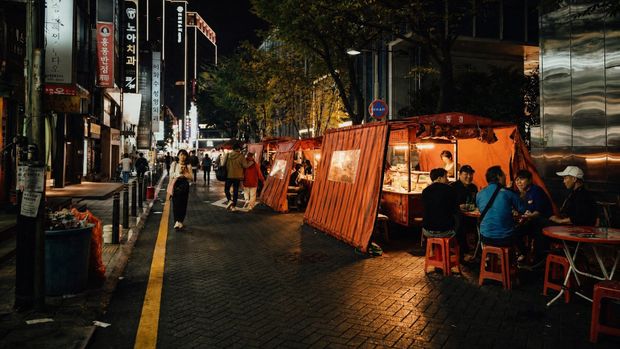
Duck under a low plastic flap on a Seoul side street after dark and you enter one of Korea's most enduring social institutions: a tent kitchen where soju flows, fish cake steams, and — until 1972 — grilled sparrow sat on the menu. This is the pojangmacha, and its plastic tarps are the whole point.
What Is a Pojangmacha — and Why Does It Have Plastic Tarps?
A pojangmacha (포장마차), usually shortened to "pocha," is a South Korean outdoor eatery built inside a small tent or cart that sells quick food and, especially at night, alcohol paired with anju — dishes meant specifically to accompany drinking. The name translates literally as "covered wagon," from po-jang (covering or wrapping) and ma-cha (cart or carriage). In other words, it is a tented cart, not merely a stall — and the tent is what defines it.
Quick Answer: A pojangmacha ("pocha") is a South Korean street tent-bar whose name means "covered wagon." Orange or red tarpaulin walls enclose a semi-private space with stools where patrons drink soju, makgeolli, and beer with anju. It mostly runs from evening into early morning, with alcohol as the organizing logic.
What separates a pocha from an ordinary daytime food cart is the enclosure. Plastic tarps — traditionally orange or red — hang from each side to wrap the stall into a food tent, with stools, benches, or tables inside where patrons sit close together to eat and drink, according to Matador Network. That semi-private, curtained interior is the source of the pocha's intimacy, and the reason it reads as a distinct space rather than a spot on the sidewalk.
The category is not one fixed object. It spans a mobile or semi-fixed tarp-wrapped cart, a sidewalk tent with stools, food stalls inside traditional markets, and newer indoor bars that deliberately copy the tent-cart atmosphere, per Wikipedia's overview. What ties them together is timing and purpose: pocha mostly operate from evening into the early morning, and drinking is the organizing logic rather than an afterthought.
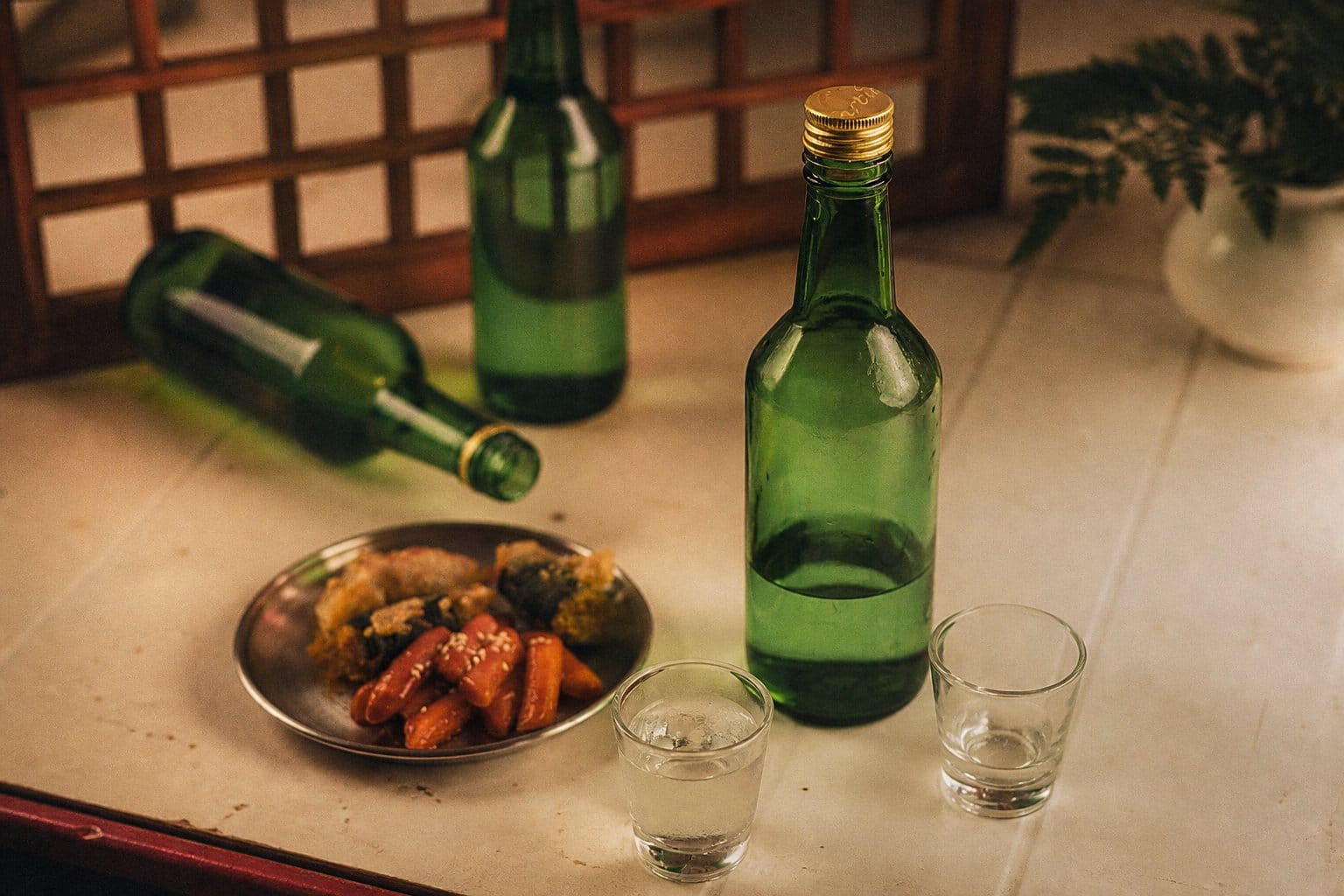
In the evening, the drink is central. The core trio is soju, makgeolli (a cloudy rice beer), and beer, each served with anju. That pairing — cheap alcohol matched to salty, spicy, warming food — is what has kept the format alive for more than seven decades, long after the grilled sparrow disappeared.
Postwar Origins: How Refugees Built Seoul's First Tent Kitchens
The modern pojangmacha traces to the 1950s, when Korean War displacement created an urban underclass that needed cheap, fast food infrastructure almost overnight. After Japanese colonial rule ended in 1945, refugees, southward migrants (월남민), and the city's poor crowded into a Seoul stripped of resources, and portable tent kitchens filled the gap . This was less an invention than an acceleration: a pre-existing cart-food tradition was turbocharged by mass internal migration and wartime poverty.
The first clusters had a specific address. In the late 1950s, early vendors gathered around Seoul's Cheonggyecheon Stream, selling eomuk (fried fish cake), hobbang, and jjinbbang (steamed buns) to workers and passersby who wanted something hot and filling for pocket change . The menu at this stage was about calories and warmth, not the drinking-focused anju spreads that would define the format in later decades.
The physical build reflected what materials were available. A 1950s cart was hand-made and mobile:
- Frame: wooden corner poles lashed at the corners of a small cart .
- Covering: thick cotton sheeting (광목, gwangmok) draped over the frame to enclose the stall .
- Lighting: carbide lamps, since electricity was not something a mobile street stall could count on .
Every element served the same logic. A vendor needed a kitchen that could be assembled at dusk, packed away before dawn, and moved when authorities or business demanded it. Wooden poles and cotton sheeting were cheap and light; carbide lamps needed no grid connection. The result was a self-contained, low-capital business that a displaced family could start with almost nothing and run through the night.
As Matador Network's cultural coverage frames it, the tent was never only about food. "The pojangmacha is a great equalizer, a place where hierarchy dissolves over shared soju and cheap anju," writes Matador Network in its survey of the format's history and social role (source: Matador Network). That democratic character was seeded in these postwar years, when the tent kitchen was one of the few places the war-displaced could earn a living and eat side by side with anyone else.
From this Cheonggyecheon base, the format was primed to grow. The cotton-and-carbide cart of the 1950s carried steamed buns and fish cake; within two decades it would gain tables, brighter lighting, and a very different menu built around late-night drinking — including one item, grilled sparrow, that the law would eventually take off the table entirely.
The Grilled Sparrow Era: What Disappeared from the Menu by 1972
Grilled sparrow — chamse-gui (참새구이) — was once a standard anju at Seoul's tent kitchens, a small, cheap, protein-rich snack cooked over charcoal to accompany soju, and it vanished as a food item when the Wildlife Protection Act (조수보호법) took effect in 1972 . That single legal date is the cleanest marker historians have for how early pocha food changed: one law drew a line, and an entire category of anju moved from ordinary to illegal essentially overnight.
Sparrow was never a novelty item in this setting. Records of early pocha menus compiled in the Academy of Korean Studies' Encyclopedia of Korean Culture list chamse-gui alongside a roster of now-uncommon dishes that defined the postwar drinking tent: grilled chicken feet, liver, tripe, boiled squid, and salt-grilled saury (꽁치) . These were organ-heavy, small-portion, low-cost foods — the kind of anju that made sense when meat was expensive and vendors served refugees, migrants, and low-wage workers looking for warmth and a drink rather than a full meal.
The disappearance of sparrow tracks Korea's broader economic arc. As incomes rose through the industrializing 1970s and beyond, the tent menu grew more varied and more expensive, and cheap protein snacks built on birds and offal gave way to the tteokbokki, sundae, and grilled skewers that dominate the format today. What stayed constant was the logic of the food: nearly everything on a pocha counter is anju, chosen to pair with soju, makgeolli, and beer rather than to stand alone . The 1972 law simply removed one option and left the rest of that drinking-first structure intact.
As the Encyclopedia of Korean Culture notes in its account of the format, "포장마차의 안주는 시대에 따라 바뀌었다" — pocha anju changed with the times — a plain observation that captures why a dish common in 1965 can be a legal impossibility a decade later . The wildlife statute was a conservation measure, not a food-safety one, but its effect on the tent kitchen was decisive: wild sparrows could no longer be caught and sold, so the item left the menu and did not return.
For anyone trying to date a photograph or a memory of an old Seoul tent, the sparrow line is useful precisely because it is fixed. A menu offering chamse-gui almost certainly predates 1972; one built around spicy rice cakes, fish-cake skewers, and grilled chicken skewers belongs to the decades after. The physical tent would keep evolving too — from cotton sheeting and carbide lamps toward vinyl and electric light — but the food, unlike the hardware, carried a hard legal timestamp that still helps place each era of the pocha in Korea's larger story of scarcity giving way to growth.
How the Tent Evolved: Cotton to Vinyl, Carbide to LED
The pocha's hardware changed one material at a time, tracking Korea's postwar economy from scarcity to surplus. In the 1950s and 1960s the tent was a nightly assembly job: wooden corner poles, thick cotton sheeting known as gwangmok (광목), and carbide lamps for light, all dismantled and wheeled away after closing . There was no fixed electricity and no plumbing; the cart was the business, and the business moved.
Industrialization reshaped the structure in the 1970s. As Seoul's "palli-palli" (hurry-up) growth kept office workers out late, tents grew larger, added fixed tables, and switched to sturdier materials: metal frames replaced wood, vinyl and tarpaulin replaced cotton, and electric bulbs replaced the carbide flame . The orange-and-red tarp silhouette most people picture today dates from this decade, when a mobile night cart began settling into a semi-fixed sidewalk fixture.
The next jump came from the mid-1980s in Gangnam, where upscale versions installed dedicated electricity and water plumbing for the first time . Plumbing meant the pocha no longer had to be broken down each night, and that permanence seeded a higher-end, larger-format trend — the direct ancestor of the indoor pojangmacha (실내포장마차) chains that now operate as licensed restaurants and pubs, such as Hanshin Pocha, which recreate the retro tent atmosphere indoors .
| Era | Frame | Covering | Lighting | Setup |
|---|---|---|---|---|
| 1950s–60s | Wooden poles | Cotton (gwangmok) | Carbide lamp | Dismantled and moved nightly |
| 1970s | Metal frame | Vinyl / tarpaulin | Electric bulb | Larger, semi-fixed, added tables |
| Mid-1980s (Gangnam) | Metal, reinforced | Vinyl | Wired electricity | Dedicated power + water plumbing |
| Today | Varies by format | Vinyl or building walls | Fluorescent / LED | Sidewalk, market, or indoor |
Lighting kept modernizing after the tarp did: incandescent gave way to fluorescent tubes and, more recently, LED . The result is that the pocha now exists as three parallel forms rather than one. The sidewalk tent cart — the original moving kind — is declining in central Seoul under road and sanitation pressure. The licensed market stall survives inside places like Gwangjang Market with fixed power and water. And the indoor pojangmacha chain packages the whole aesthetic — vinyl-look walls, low stools, soju and eomuk broth — as a permanent, card-accepting restaurant . The tent that once folded up every night has, in effect, split into a version that stays.
The Pocha Menu Today: What to Order and What It Costs
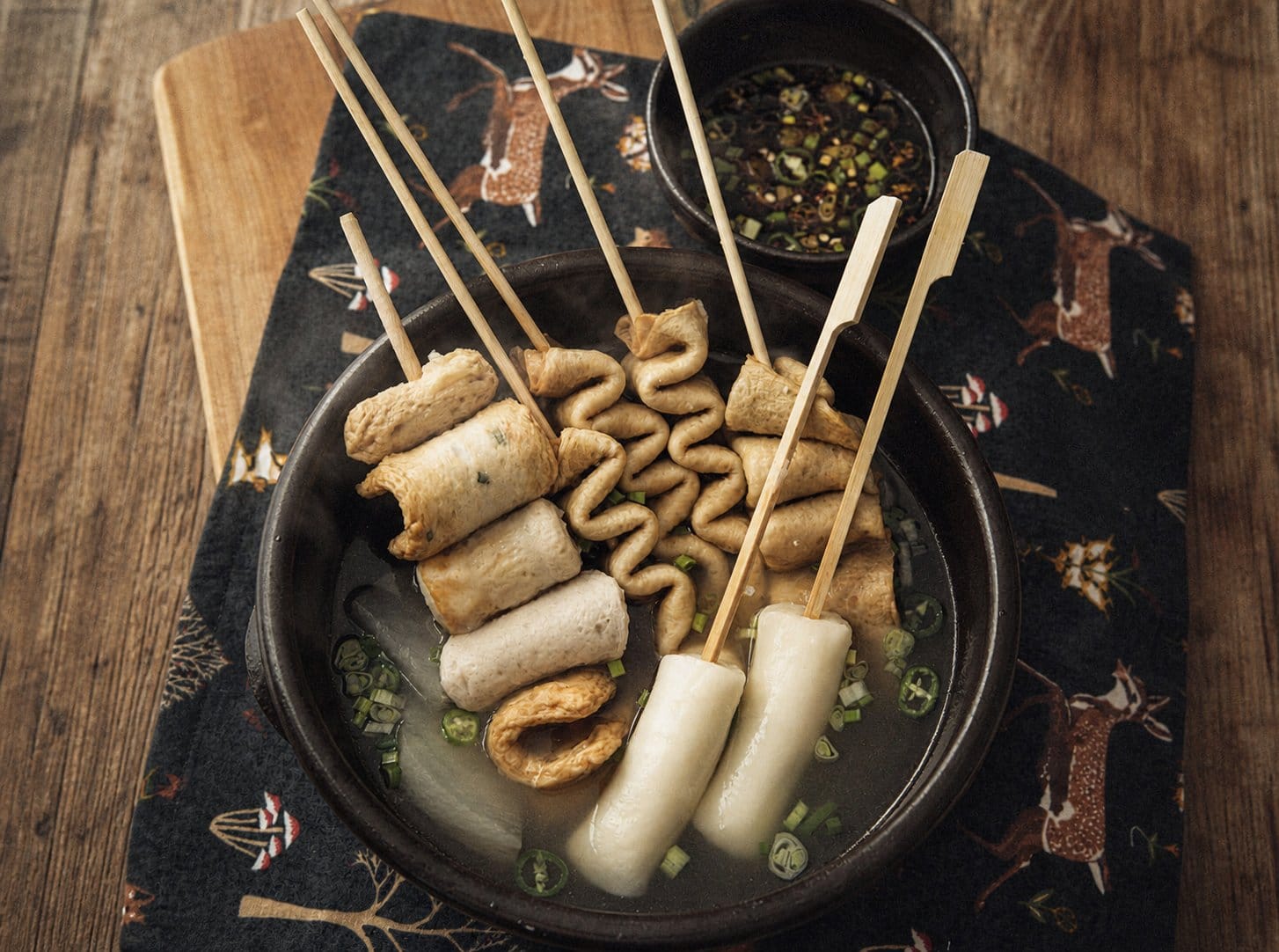
The pocha menu is built almost entirely around anju — food designed to accompany soju, makgeolli and beer rather than stand alone — and it splits into an approachable core tier and a more adventurous one. The everyday backbone is cheap, hot and shareable: tteokbokki (chewy rice cakes in spicy gochujang) at roughly ₩5,000, eomuk/odeng fish-cake skewers pulled from a simmering broth at about ₩2,000 a skewer, plus sundae (blood sausage stuffed with sweet-potato glass noodles), dak-kkochi (grilled chicken skewers), twigim (battered, deep-fried vegetables and seafood) and bindaetteok (mung-bean pancakes) .
Order deeper into the menu and you reach the tier that regulars come for: gopchang (grilled intestines), dakbal (spicy chicken feet), jokbal (braised pig trotters, prized for their collagen), golbaengi (whelks tossed in a tangy sauce) and sannakji (freshly cut octopus served still moving) . These pair with the drinking that defines the evening trade, which is why they anchor most tent menus after dark.
| Item | What it is | Approx. price |
|---|---|---|
| Tteokbokki | Rice cakes in spicy gochujang | ~₩5,000 |
| Eomuk/odeng skewer | Fish cake in broth | ~₩2,000 |
| Kalguksu (Pink Lady) | Knife-cut noodle soup (₩8,000 with mandu) | ~₩7,000 |
| Bindaetteok (Pink Lady) | Mung-bean pancake | ~₩5,100 |
| Gopchang / dakbal / jokbal | Adventure-tier anju | Market rate, varies |
Gwangjang Market shows how the format scales into a fixed stall. There the "Pink Lady," Yun Sun — made famous by Netflix's Street Food: Asia — sells kalguksu for about ₩7,000 (₩8,000 with mandu) and bindaetteok for ₩5,100 (video: Angelica & Aileen Wanders). Those numbers are useful price anchors, though a daytime licensed market stall is technically distinct from the tented, alcohol-serving evening pocha.
Part of what you are paying for is technique. Seoul market coverage documents double-frying — vendors fry twigim in advance, then re-fry each order to crisp it just before serving — and kimari, glass-noodle-stuffed fried rolls dipped in gochujang, both signature production methods that keep the food fast and crunchy on a small cart burner (video: Doobydobap). The result is a menu that reads cheap on paper but rewards ordering across both tiers: a plate or two of core anju to share, one adventurous skewer, and a bottle to pour.
Where to Find a Real Pocha in Seoul (and Busan)
The most iconic surviving tent street in Seoul runs through Jongno 3-ga, along the roughly 200-meter stretch beside Ikseon-dong between subway exits 5 and 6 . After dark this row fills with orange-tarp tents serving soju alongside grilled skewers and stir-fries, and it remains the clearest place to see the old sidewalk format still operating rather than simulated indoors .
Nearby Gwangjang Market is the daytime counterpart, a covered market known for bindaetteok (mung-bean pancakes) and mayak gimbap, the bite-sized "addictive" seaweed rolls . It is also where the vendor Yun Sun — the "Pink Lady" featured on Netflix's Street Food: Asia — sells kalguksu for about ₩7,000 and bindaetteok for ₩5,100 (video: Angelica & Aileen Wanders).
Across the river, the Yeongdeungpo pocha row has its own specialty: golbaengi, the spiced whelks that pair naturally with soju and beer . It draws a more local, after-work crowd than the tourist-heavy central markets, which makes it a useful stop for travelers who want the drinking-tent atmosphere without the sightseeing queue.
Outside Seoul, the major alternative is Busan, where tents cluster near Haeundae Beach and trade the alley setting for a seaside one . For fans routing a concert trip through both cities, it is the easiest way to sample the format away from the capital.
Scale matters for setting expectations. A widely cited estimate held that Seoul had roughly 3,100 pocha in 2012, and no authoritative citywide count has been verified since, so treat that figure as historical rather than current . The number has clearly declined in central districts as sidewalk tents were removed or formalized, but the format persists through markets, the Jongno tent street, and licensed indoor chains — so the pocha experience is easier to find than the shrinking cart count alone would suggest .
Pocha Etiquette, Legal Status, and Why Many Tents Don't Take Cards
Many sidewalk pocha operate cash-first because they sit in a legal grey zone rather than as fully registered restaurants. A classic tented cart on a public sidewalk touches two separate laws at once: Korea's Food Sanitation Act, which requires food businesses to be reported, permitted or licensed, and the Road Act, which governs the occupation of public roads and pavements . A stall that is not reported as a food service business, and that occupies a sidewalk without road-use permission, can fall short of both frameworks at the same time.
That dual uncertainty is exactly why old sidewalk tents have been handled case by case in central Seoul — removed in some districts, relocated in others, and quietly tolerated elsewhere . Because a tent's status can shift with a single enforcement decision, owners tend to avoid card terminals and paper trails, so bringing cash is the safe default. It also explains why the more visible survivors are now inside markets or licensed indoor chains, where the compliance question is already settled.
The contrast with food trucks is instructive. South Korea legalized food trucks in 2014, but only in designated venues and with local reporting — a deliberately formal model, closer to a registered mobile restaurant than to an informal roadside tent . The tent cart never received an equivalent clean legal lane, which is part of why it has been pushed toward markets and indoor formats.
Once you are seated, the drinking customs matter as much as the food. The unwritten rules at a pocha are consistent across guides:
- Order at least one drink per person — the tent runs on soju, makgeolli and beer sales, not just anju .
- Never top off a cup that isn't empty — wait until it is drained before pouring again.
- Use two hands when pouring for, or receiving from, someone older than you.
- Don't tip — tipping is not expected and can read as awkward.
"Bring cash, order at least one drink per person, and follow Korean pouring customs — never fill a cup that isn't empty, and use two hands with elders," advises Matador Network's pojangmacha guide (source: Matador Network).
None of this is gatekeeping; it is the etiquette that keeps a small tent, close seating and shared bottles comfortable for everyone under the tarp.
From K-Drama Sets to Los Angeles: How Pocha Became a Global K-Culture Symbol
The pojangmacha is now globally legible shorthand for Korean intimacy, carried far beyond Seoul's sidewalks by film, television and pop music. On screen the red-tarp tent has become visual code for honest, after-hours conversation. It anchors Lee Jang-ho's 1980 film A Fine, Windy Day , and reappears across My Sassy Girl, Reply 1988, Itaewon Class, Crash Landing on You, and Squid Game, where Gi-hun buys tteokbokki under a red tent . For international viewers who never sat under a tarp, these scenes taught the format's grammar: cheap soju, close seating and unguarded talk.
"Pojangmacha are romanticized as confession booths, where Koreans drink soju and speak with unusual emotional honesty," notes Matador Network's pojangmacha guide.
Music sealed the image. PSY's 2013 "Gentleman" video staged a generic pocha-like setting stocked with tteokbokki, ramyeon, fish cake, soju and beer, exporting the tent aesthetic to a global audience . That visual shorthand now travels wherever K-culture goes.
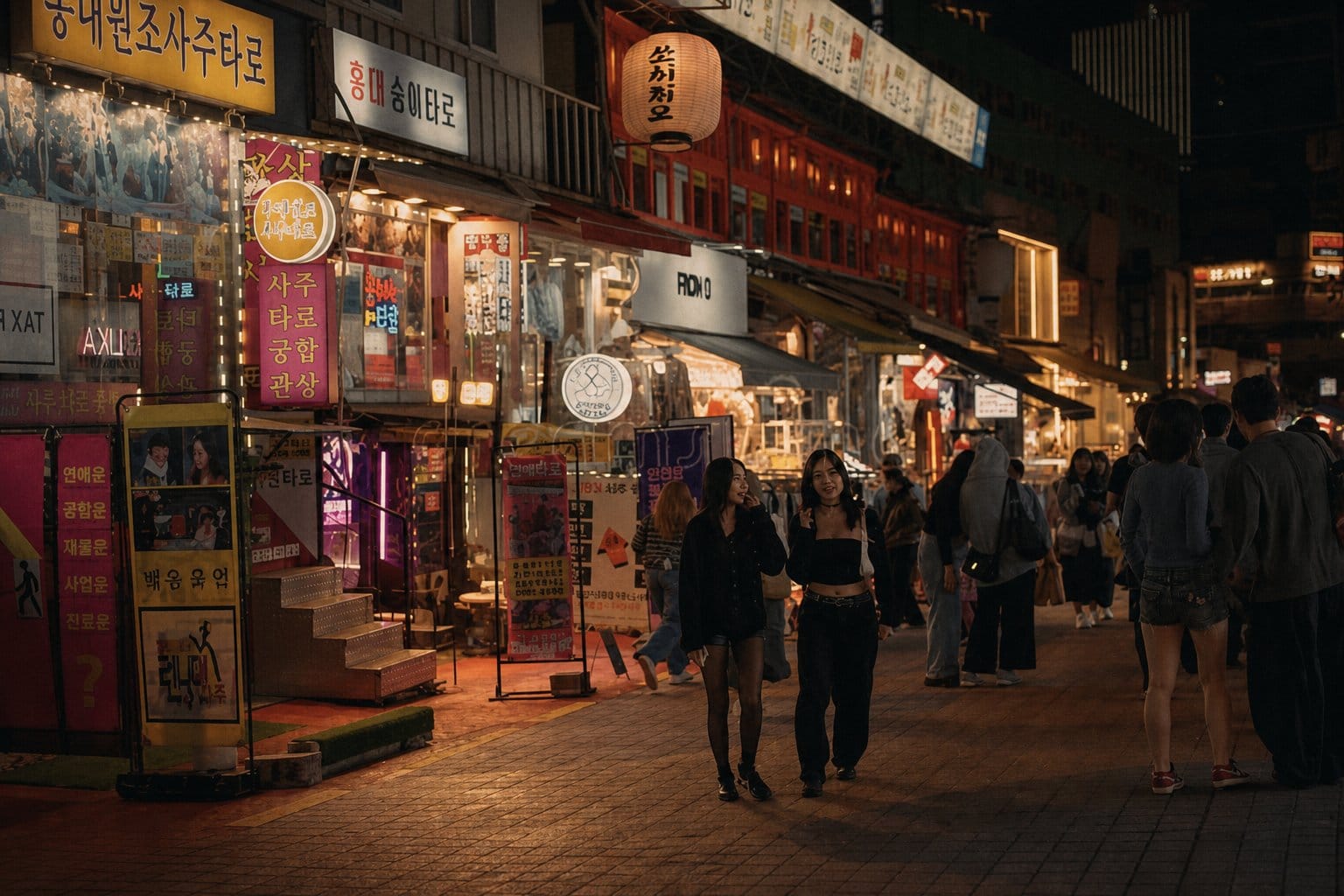
At home, the format is being reinvented rather than abandoned. A nostalgic "NEW-PO" trend among MZ-generation diners in their 20s and 30s revives the retro tent mood with cleaner aesthetics, driving licensed indoor pojangmacha (실내포장마차) chains that recreate the atmosphere as permitted restaurants and pubs . It is a generational handoff: the same close seating and shared bottles, minus the carbide lamp and the legal gray zone covered earlier in this piece.
The concept has also emigrated with the Korean diaspora. Go Pocha in Los Angeles' Koreatown is a documented overseas example, transplanting the tent-bar template to a licensed American storefront . What began as postwar survival infrastructure around Cheonggyecheon has become a portable cultural product.
The concrete takeaway: the sidewalk tent cart that once grilled sparrow until 1972 has thinned out in central Seoul, but the pojangmacha itself did not die — it split into a screen icon, an MZ revival concept and a diaspora export. Whether you find it in a Jongno alley, a K-drama frame or a Koreatown storefront, the constant is the format's promise of cheap food, close company and a low bar to sitting down with strangers.
Frequently asked questions
What does pojangmacha mean in Korean?
Pojangmacha (포장마차) is a literal compound: po-jang (covering or wrapping) plus ma-cha (cart or carriage), so it translates to "covered cart" or "covered wagon" . The name points to the tented tarp structure that defines the format. In everyday speech Koreans usually shorten it to "pocha."
Why did grilled sparrow disappear from pocha menus?
Grilled sparrow (참새구이) vanished because the Wildlife Protection Act (조수보호법) took effect in 1972, making it illegal to sell sparrows as food . Before that, chamse-gui was a standard anju (drinking food) item at Seoul's tent bars, alongside grilled chicken feet, liver, tripe and salt-grilled saury.
Are pojangmacha legal in South Korea?
There is no single "pojangmacha" legal category. Depending on location, a stall may be licensed within a market, informally tolerated, or technically in breach of the Food Sanitation Act (which requires food businesses to be licensed, permitted or reported) and the Road Act (which regulates occupation of public roads) . That patchwork is why many older sidewalk pocha have been removed or relocated in central Seoul.
What food and drinks do pojangmacha typically serve?
The core drinks are soju, makgeolli (rice beer) and beer, and the food is anju meant to accompany drinking . Common anju includes tteokbokki, eomuk (fish cake) skewers in broth, sundae (blood sausage), dak-kkochi (chicken skewers) and twigim. Higher-end tents add gopchang (intestines), jokbal (pig trotters), golbaengi (whelks) and sannakji (live-cut octopus).
Where is the best area to visit a pojangmacha in Seoul?
Jongno 3-ga — the roughly 200-meter stretch by Ikseon-dong between subway exits 5 and 6 — is Seoul's most famous surviving tent street . Gwangjang Market is known for bindaetteok and mayak gimbap, while Yeongdeungpo's pocha row is known for golbaengi. Outside Seoul, the tents along Busan's Haeundae Beach are a notable alternative.
Enjoyed this article? Subscribe to get new stories by email whenever they're published.
This article was written using information collected and analyzed by NAMANE's in-house K-pop research AI engine. We use AI technology to bring you faster, broader coverage, and in the process some details may occasionally differ from the latest facts. For important information such as dates, venues, and prices, please double-check with official sources.


